Best Emergency Flashlight: What To Look For Before The Next Power Outage
The Best Emergency Flashlight For Power Outages
When the lights suddenly go out during a thunderstorm, hurricane, winter storm, or neighborhood blackout, one of the first things you reach for is a flashlight. But finding the best emergency flashlight is about more than buying the brightest model on the shelf. You need something dependable, easy to find in the dark, simple enough for everyone in the family to use, and powered by batteries you can realistically keep available.
The good news is that a reliable emergency lighting setup does not have to cost a fortune.
A few well-placed LED flashlights, spare batteries, and perhaps a rechargeable lantern can make a dark home much easier and safer to manage. More importantly, having dependable lighting eliminates one small but stressful problem when you are already dealing with an emergency.
Here is how to choose a flashlight that fits real-world preparedness rather than just impressive numbers on a package.
🔦 Quick Answer: What Is The Best Emergency Flashlight?
The best emergency flashlight is a dependable LED model with multiple brightness settings, good battery life, simple controls, durable construction, and a power source you can easily replace or recharge. For most households, extreme brightness is less important than reliability and runtime. Ideally, keep more than one flashlight and use a mix of battery-powered and rechargeable lighting so one failed battery or charging problem does not leave your family in the dark.
Key Takeaways
Most likely cause: Power outages caused by storms, grid problems, accidents, wildfires, or damaged electrical infrastructure are the most common situations where emergency lighting becomes essential.
Usually serious? Not necessarily, but darkness can increase the risk of falls, injuries, confusion, and difficulty responding to other problems.
First thing to check: Make sure your best emergency flashlight choice works, has usable batteries, and is stored somewhere everyone in the household can quickly find.
Best solution: Keep several reliable LED flashlights in different locations, along with spare batteries and at least one alternative lighting option such as a rechargeable lantern.
💡 Why Every Home Needs Reliable Emergency Lighting
Most people already own a flashlight. The bigger question is whether they could actually find it—and whether it would work—during an unexpected blackout.
A flashlight buried beneath tools in the garage is not very useful when the power goes out at 2 a.m.
Neither is a flashlight containing batteries that leaked two years ago.
Emergency lighting matters because power failures create immediate practical problems. You may need to safely walk downstairs, check a circuit breaker, locate medication, prepare food, help children, inspect storm damage, or evacuate your home.
A dependable flashlight can also reduce anxiety. Instead of searching through drawers with your phone’s flashlight, you already know where your equipment is.
The best emergency flashlight is therefore not necessarily the most expensive. It is the one that is dependable and available when you actually need it.
🔆 How Bright Should An Emergency Flashlight Be?
Flashlight brightness is normally measured in lumens.
More lumens generally mean more light, but brighter is not automatically better.
For routine indoor emergency use, a lower or medium setting may be more practical because it provides plenty of visibility while extending battery life.
A flashlight capable of roughly 100 to 500 lumens can handle many household preparedness tasks. Higher-output models can be useful for inspecting a yard, checking property after a storm, or seeing farther outdoors.
Look for multiple modes rather than chasing the highest possible lumen number.
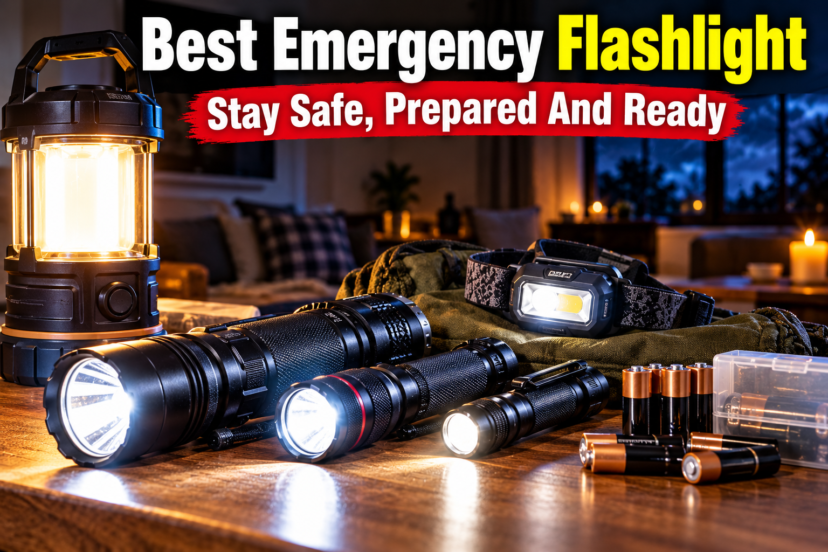
A best emergency flashlight candidate might offer:
- Low Mode For Long Runtime
- Medium Mode For Normal Household Tasks
- High Mode For Outdoor Visibility
- Simple Controls That Work Under Stress
An ultra-bright flashlight that drains its battery rapidly may be less useful during a three-day outage than a modest flashlight capable of operating for many hours.
🔋 Choose The Right Battery Type
The power source deserves just as much attention as brightness.
Emergency flashlights commonly use disposable alkaline batteries, rechargeable lithium-ion batteries, or rechargeable standard-size batteries such as AA or AAA cells.
Each option has advantages.
Disposable Battery Flashlights
AA and AAA flashlights are easy to understand and can be convenient during long emergencies because fresh batteries can be swapped in quickly.
If you use them, keep a reasonable supply of compatible batteries in your preparedness kit and check them periodically.
Do not assume the batteries inside an unused flashlight will remain ready forever.
Rechargeable Emergency Flashlights
Rechargeable models can be excellent for frequent use and may save money over time.
They work especially well when paired with a portable power station, vehicle USB port, or other appropriate backup charging method.
The weakness is obvious: during a prolonged grid outage, eventually you need somewhere to recharge them.
For that reason, a resilient household may benefit from having both rechargeable and replaceable-battery flashlights rather than depending entirely on one system.
🛠️ Look For Durability And Water Resistance
Your flashlight may be used in much harsher conditions during an emergency than during normal life.
Imagine checking your property during heavy rain after a hurricane or trying to change a tire during a winter storm.
That is why the best emergency flashlight should be reasonably durable.
Look for features such as impact resistance and an IP water-resistance rating appropriate for your intended use.
You do not necessarily need an expensive tactical flashlight built for extreme conditions. A sturdy household model that tolerates occasional drops and wet weather may be enough for most families.
Also consider grip.
A flashlight that becomes extremely slippery when wet can be frustrating during rain, snow, or stressful conditions.
🏠 Keep More Than One Emergency Flashlight
One flashlight is not an emergency lighting plan.
What happens if someone takes it upstairs while another family member needs light in the kitchen?
Or if it breaks?
A better approach is distributing several affordable flashlights throughout your home.
Useful locations include:
- Beside Your Bed
- In Your Main Emergency Kit
- Near The Kitchen
- Near An Exit
- In Your Vehicle
- In A Work Or Commuter Bag
Every family member old enough to use one safely can have access to a flashlight.
This redundancy is one of the simplest urban preparedness strategies.
Instead of buying one extremely expensive light, you may get more practical value from several reliable mid-priced lights placed where you are likely to need them.
🏮 Add An Emergency Lantern To Your Setup
Flashlights are excellent for moving around, inspecting something, or directing light at a specific area.
They are less convenient when an entire family is sitting around a kitchen table during an eight-hour outage.
That is where an LED lantern becomes useful.
A lantern provides broad-area illumination and can often operate for many hours on a lower setting.
For example, during a hurricane-related outage, you could use a lantern as your primary room light and reserve the best emergency flashlight for walking through the house or checking outside.
This can conserve flashlight batteries while making the home feel more normal.
Avoid depending on candles as your main emergency lighting source. Open flames introduce an unnecessary fire hazard, especially when people are tired, distracted, or moving around in darkness.
📱 Do Not Depend Entirely On Your Phone
Modern smartphones have surprisingly useful flashlights.
They make an excellent short-term backup.
But your phone is also one of your most important emergency communication tools.
During a widespread power outage, you may need it for weather alerts, emergency notifications, maps, contacting family members, checking utility information, or calling for assistance.
Running the flashlight continuously drains the same battery you need for those tasks.
Use the phone flashlight when necessary, but do not make it your entire lighting plan.
A $15–$30 LED flashlight and some spare batteries can preserve valuable phone power during a long blackout.
🌪️ Match Your Flashlight Plan To Your Local Risks
Preparedness looks different across the United States.
A family in Florida may be preparing for hurricane outages lasting several days. Someone in Texas may be concerned about severe storms or grid disruptions. Households in northern states may face ice storms and winter outages, while communities in the West may experience wildfire-related evacuations or public-safety power shutoffs.
Think about your likely situation.
If extended outages are common, prioritize long runtime and easy access to replacement batteries or backup charging.
If evacuation is your main concern, size and weight become more important.
Apartment residents may value compact flashlights and rechargeable lanterns because storage space is limited.
The best emergency flashlight is ultimately the one that matches your family’s actual risks and preparedness plan.
📋 Create A Simple Flashlight Maintenance Routine
Emergency equipment needs occasional attention.
Every few months, inspect your lights.
Turn each flashlight on and cycle through its settings. Check replaceable batteries for leakage or corrosion and inspect rechargeable batteries for swelling, damage, or other abnormalities.
Recharge devices according to manufacturer instructions.
Also check whether family members still know where the emergency lights are stored.
A five-minute inspection can prevent the frustrating discovery that your flashlight does not work precisely when you need it.
One easy habit is to check emergency lighting when you change clocks, replace smoke alarm batteries as appropriate, or perform another regular home-safety task.
⚠️ When To Consult A Professional Or Follow Official Guidance
Flashlights are simple tools, but emergencies can involve hazards that require professional assistance.
Never use a flashlight as justification for approaching downed power lines, entering a flooded electrical area, investigating a suspected gas leak, or touching damaged electrical equipment.
Contact your utility company, local emergency management agency, fire department, licensed electrician, or another qualified professional when the situation involves electrical hazards, structural damage, flooding, fire, or utility problems.
If authorities issue evacuation, shelter, wildfire, hurricane, or severe-weather instructions, follow official guidance.
People who rely on electrically powered medical equipment should discuss emergency backup arrangements with their healthcare provider and appropriate utility or emergency resources before an outage occurs.
❓ Frequently Asked Questions
What Is The Best Emergency Flashlight For A Power Outage?
For most households, the best option is a reliable LED flashlight with multiple brightness settings, long runtime, durable construction, and batteries that can easily be replaced or recharged.
How Many Lumens Should An Emergency Flashlight Have?
Around 100–500 lumens is sufficient for many normal household emergency tasks. Higher brightness can be helpful outdoors, but lower modes conserve battery power and may be more useful during long outages.
Are Rechargeable Flashlights Good For Emergencies?
Yes. Rechargeable flashlights can be excellent emergency tools, particularly if you have backup charging. However, keeping at least one flashlight that accepts common replaceable batteries provides additional redundancy.
Are AA Or AAA Flashlights Better For Emergency Preparedness?
Both can work well. The important factor is choosing a battery size you can easily stock and standardizing your emergency equipment where practical. Using fewer battery types simplifies your preparedness supplies.
Should Every Family Member Have A Flashlight?
Ideally, multiple family members should have easy access to a flashlight. You do not necessarily need an expensive flashlight for each person, but having several lights prevents everyone from depending on one device.
Is A Flashlight Or Lantern Better For A Power Outage?
Ideally, have both. Flashlights provide directional light for walking and inspections, while lanterns illuminate a larger area and are useful for kitchens, living rooms, and family gathering spaces.
How Often Should I Check My Emergency Flashlights?
Check them every few months and before predictable severe-weather seasons. Test operation, inspect batteries, recharge rechargeable models, and replace damaged equipment when necessary.
🏡 A Good Flashlight Is A Small Investment In Self-Reliance
Choosing the best emergency flashlight is not about owning the most powerful or expensive piece of survival gear.
It is about removing one predictable problem before an emergency happens.
Start small. Buy or identify a dependable flashlight. Put it somewhere easy to reach. Add spare batteries. Place another flashlight beside your bed or in your emergency kit. Then consider adding a rechargeable lantern or backup charging option.
These simple preparations can make a dark home feel far more manageable during a hurricane, winter storm, wildfire, grid failure, or ordinary neighborhood blackout.
Self-reliance grows through small decisions like these. You do not need to prepare for every possible disaster overnight. Build your supplies gradually, learn how to use what you own, and focus on practical equipment that solves real problems.
The next time the lights go out, instead of wondering where the flashlight is, you can simply reach for it—and move on to taking care of your family.
Disclaimer: This article is provided for general educational and preparedness purposes only. Emergency conditions, individual needs, local regulations, and regional hazards vary. Always follow applicable laws, official emergency guidance, utility instructions, and equipment manufacturer directions. Contact qualified professionals when dealing with electrical, structural, medical, fire, gas, or other potentially dangerous situations.
Explore more:
- Solar Charger For Emergencies: How To Keep
- Refrigerator During Power Outage
- Best Generator Safety Tips: 12 Rules