First Hour Blackout Survival: What To Do In The First 60 Minutes Of A Power Outage
How To Prepare For The First Hour Of A Blackout
For first hour blackout survival, first check that everyone is safe and determine whether the outage affects only your home or the surrounding area. Get flashlights, check official utility or emergency alerts, keep refrigerator and freezer doors closed, conserve phone batteries, and unplug or switch off sensitive electronics when appropriate. Then gather water, medications, lighting, power banks, and other essentials so you are ready if the outage continues for several hours or longer.
Make Sure Everyone Is Safe
The lights suddenly disappear. The refrigerator stops humming. Your Wi-Fi goes down, the house becomes unusually quiet, and everyone starts asking the same question: How long is the power going to be out? A simple first hour blackout survival plan can prevent those first uncertain minutes from turning into unnecessary stress.
Most power outages are manageable. But whether the cause is a summer thunderstorm, hurricane, winter ice storm, wildfire, equipment failure, or wider grid problem, you usually do not know immediately whether electricity will return in 10 minutes or 10 hours.
That is why the first hour matters.
You do not need expensive survival gear or advanced emergency training. Your priorities are simple: make sure everyone is safe, determine what happened, protect food and battery power, gather essential supplies, and prepare calmly in case the outage lasts longer than expected.
Here is what to do, step by step.
Key Takeaways
Most likely cause: Severe weather, utility equipment problems, damaged power lines, vehicle accidents, wildfire conditions, or other local grid disruptions.
Usually serious? Most short outages are manageable, but extreme temperatures, medical equipment needs, electrical hazards, flooding, fires, and prolonged outages can make the situation more serious.
First thing to check: Make sure everyone is safe, then determine whether the blackout affects just your home or the surrounding neighborhood.
Best solution: Follow a calm first hour blackout survival routine: check safety, get reliable lighting, protect refrigerated food, conserve batteries, monitor official information, and prepare for a longer outage.
🕐 Minutes 0–10: Check Immediate Safety First
Your first instinct may be to find out when the electricity will return.
Safety comes first.
Pause and look around. Make sure children, older family members, and anyone who needs assistance are okay.
If it is dark, use a flashlight rather than walking around blindly.
Check for obvious hazards such as:
- Smoke Or Fire
- Burning Electrical Smells
- Sparking Equipment
- Downed Power Lines Outside
- Floodwater Near Electrical Equipment
- Storm Damage To Your Home
If you smell gas, see a fire, encounter a downed line, or notice another immediate danger, move to safety and contact the appropriate emergency service or utility.
Never approach a fallen electrical line. Treat it as energized.
Your first hour blackout survival plan should begin with people—not appliances.
Once everyone is safe, move to the next step.
🔦 Minutes 10–15: Get Your Emergency Lighting
Next, retrieve flashlights and lanterns.
Ideally, these should already be stored in predictable locations rather than scattered around the house.
Use LED flashlights, headlamps, or battery-powered lanterns as your main emergency lighting.
Avoid depending on candles. Open flames create an unnecessary fire risk during a situation when rooms are dark, and people may be distracted.
Your phone flashlight is useful temporarily, but preserve the phone battery whenever possible. Your phone may become your primary source of weather alerts, utility updates, maps, and communication.
A simple lighting setup might include:
- Flashlight Beside Each Bed
- Lantern In The Main Living Area
- Headlamp In The Emergency Kit
- Spare Batteries In One Known Location
Reliable lighting immediately makes a blackout feel more manageable.
🏘️ Minutes 15–20: Determine How Large The Outage Is
Now figure out what happened.
Look through a window. Are neighboring homes and streetlights also dark?
If your neighbors still have electricity, the problem may be limited to your home.
Check your electrical panel only if it is safe to do so and you know how to use it. A tripped breaker may explain the problem.
Do not repeatedly reset a breaker that continues tripping. That can indicate an electrical problem requiring professional attention.
If the entire neighborhood appears dark, check your electric utility’s outage information using your phone.
During hurricanes, winter storms, wildfires, or other major emergencies, also monitor official local emergency alerts.
Knowing whether you are facing a household electrical problem or a regional outage helps determine the next stage of your first hour blackout survival plan.
🧊 Minutes 20–25: Protect Your Refrigerator And Freezer
Do not open the refrigerator just to check whether it is still cold.
Keep the doors shut.
According to standard U.S. food-safety guidance, an unopened refrigerator can generally keep food cold for about four hours. A full freezer can maintain its temperature for approximately 48 hours, while a half-full freezer may stay cold for around 24 hours, provided the door remains closed.
That gives you time.
Write down approximately when the outage began.
If the electricity stays off, knowing the outage start time will help you make safer food decisions later.
Do not transfer everything into coolers during the first few minutes unless circumstances make that necessary. Every refrigerator opening releases cold air.
For now, keep it closed.
📱 Minutes 25–30: Start Conserving Battery Power
At the half-hour mark, assume the outage could last longer than expected.
Start conserving energy.
Put phones into battery-saving mode. Reduce screen brightness and turn off unnecessary background functions.
If you have power banks, locate them—but do not automatically start charging every device.
Save your stored electricity for when you actually need it.
Prioritize:
- Phones Needed For Communication
- Medical And Safety Equipment
- Emergency Radios
- Flashlights And Headlamps
- Other Useful Devices
Avoid wasting limited battery capacity on entertainment unless you have plenty of backup power.
If your household has a solar charger for emergencies, portable power station, or other backup charging system, locate it now so it is available later.
🚰 Minutes 30–40: Check Water And Essential Household Needs
In many municipal systems, the water may continue flowing normally during a power outage.
But not every household can assume this.
Homes that rely on electric well pumps may lose running water when the power fails. Apartment buildings can also experience water problems if pumps or building systems are affected.
If you have reason to believe your water supply could become unreliable, check official guidance and use your stored emergency water carefully.
This is also a good time to gather essential medications.
If someone in the household uses medication that requires refrigeration, follow the medication’s specific storage instructions and contact a pharmacist, healthcare professional, or manufacturer when necessary.
Do not guess about temperature-sensitive medication.
Your first hour blackout survival plan should account for the specific needs of your household.
🎒 Minutes 40–50: Gather Your Essential Supplies
You do not need to drag every emergency supply into the living room.
Gather what you are likely to need over the next several hours.
That could include:
- Flashlights And Lanterns
- Spare Batteries
- Power Banks
- Drinking Water
- Essential Medications
- Battery Or Hand-Crank Radio
- First-Aid Kit
- Warm Clothing Or Blankets
- Shelf-Stable Snacks
- Charging Cables
- Emergency Contact Information
Put everything in one convenient location.
This prevents repeated trips around a dark house looking for equipment.
If severe weather is still occurring, keep shoes nearby. Broken glass, storm debris, or other hazards can make walking barefoot dangerous.
Families with young children can also add a familiar game, book, or comfort item. Keeping children calm is part of keeping the household manageable.
📻 Minutes 50–60: Check Official Information And Make A Longer-Term Plan
By now, you should have a better idea of what you are dealing with.
Check your utility’s outage information and official emergency alerts.
If restoration is expected soon, you may simply need to wait.
If there is no restoration estimate—or a major storm has caused widespread damage—switch from first hour blackout survival to longer-term outage planning.
Think about:
- Food And Refrigeration
- Drinking Water
- Indoor Temperature
- Backup Power
- Communication
- Medical Needs
- Cooking
- Sanitation
- Security
- Possible Evacuation
You do not have to solve every problem immediately.
Your goal is to identify which problems could become important next.
That keeps you ahead of the emergency instead of constantly reacting to it.
🔌 What Should You Unplug During A Blackout?
It can be sensible to switch off or unplug sensitive electronics during an outage, particularly if there is concern about power fluctuations when electricity returns.
Computers, televisions, gaming systems, and other electronics do not need to remain connected.
You can leave one light switched on so you know when utility power returns.
Do not attempt to modify electrical wiring or connect a generator directly to household wiring through an improvised connection.
If you use a portable generator, follow its manufacturer instructions and established carbon monoxide safety guidance. Fuel-burning generators should never be operated inside a home, garage, basement, or other enclosed or partially enclosed area.
🌡️ Pay Attention To Heat And Cold
A blackout during mild weather may be inconvenient.
A blackout during a Texas heat wave or Minnesota winter storm can become a safety issue.
Your heating or air-conditioning system may stop operating.
Dress appropriately, close or open rooms strategically as conditions require, and monitor vulnerable family members.
Older adults, infants, people with certain health conditions, and those who depend on electrically powered medical devices may need additional help.
Do not use outdoor grills, camp stoves, or other fuel-burning outdoor appliances inside your home for heat or cooking.
Carbon monoxide is invisible and potentially deadly.
🧰 Turn The First Hour Into A Household Routine
The easiest emergency plan is one you already understand.
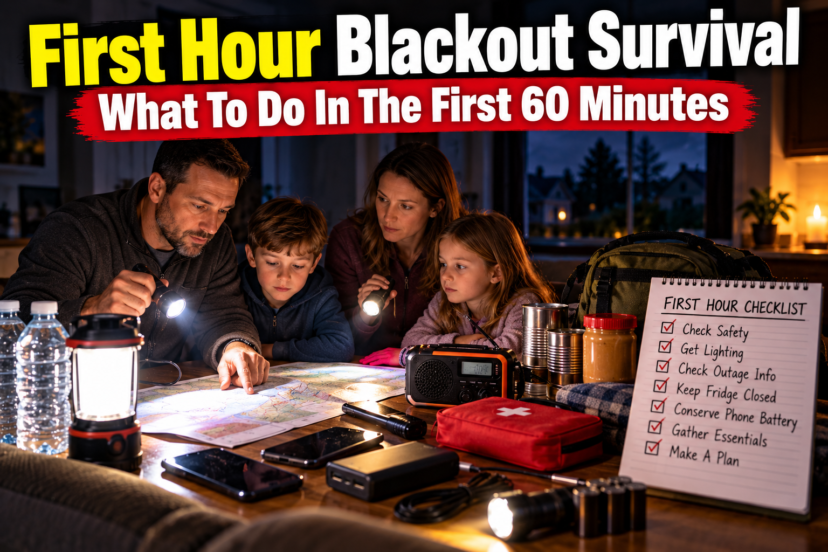
You can even write a basic first-hour blackout survival checklist and store it with your emergency supplies:
Safety → Lights → Outage Check → Refrigerator → Phones → Water → Supplies → Updates
That sequence is easy to remember. Practice it once with your family.
Switch off the lights for 15 minutes one evening and see whether everyone can locate the flashlights, power banks, emergency radio, and other essentials.
You may discover that the “emergency flashlight” has dead batteries or nobody knows where the power bank is.
Finding those problems now costs nothing.
Finding them during a hurricane is much more stressful.
⚠️ When To Consult A Professional Or Follow Official Guidance
Contact your utility, emergency services, local emergency management officials, or a licensed electrician when you encounter downed lines, electrical damage, repeated breaker problems, sparks, burning odors, flooding around electrical equipment, or other serious hazards.
Follow evacuation, shelter, wildfire, hurricane, severe-weather, and public-safety instructions issued by authorities.
People who rely on electrically powered medical equipment should develop an outage plan with healthcare professionals and appropriate utility or emergency resources in advance.
For prolonged outages involving dangerous heat or cold, seek official information about cooling centers, warming centers, shelters, and other local assistance.
❓ Frequently Asked Questions
What Should I Do First When The Power Goes Out?
First make sure everyone is safe and check for fire, electrical damage, downed power lines, gas odors, flooding, or other immediate hazards. Then get a flashlight and determine whether the outage affects only your home or the surrounding area.
Learn more: Power Outage Checklist
How Long Will Food Last In The Refrigerator Without Power?
An unopened refrigerator generally keeps food cold for about four hours. Keeping the door closed is one of the most important things you can do during the early stages of an outage.
Should I Unplug Appliances During A Power Outage?
It can be useful to unplug or switch off sensitive electronics. Follow utility and manufacturer recommendations, particularly if power fluctuations or storm-related electrical problems are possible.
Should I Turn Off The Main Breaker During A Power Outage?
Not routinely. Turning off the main breaker is not necessary for every normal utility outage. Electrical damage, flooding, generator connections, or other unusual circumstances may require different actions, so follow professional or utility guidance.
Can I Use My Gas Stove During A Power Outage?
Follow the appliance manufacturer’s instructions and local safety guidance. Never use a gas oven or range to heat your home. If you smell gas or suspect a leak, leave the area and contact the appropriate emergency or utility service.
How Can I Charge My Phone During A Blackout?
Use a charged power bank, compatible portable power station, appropriate vehicle charging option, or solar charger. Conserve power by lowering screen brightness and enabling battery-saving mode.
How Long Should I Prepare For A Power Outage?
A good household emergency plan should be capable of handling more than a brief interruption. Build supplies gradually around your local risks and follow current recommendations from emergency management authorities for food, water, medication, communication, and other essentials.
🏡 The First Hour Is About Staying Calm And Getting Ahead
Good first hour blackout survival is not about immediately switching into disaster mode.
It is about making a handful of smart decisions while you still have plenty of options.
Check your family. Get dependable lighting. Determine what happened. Leave the refrigerator closed. Conserve phone batteries. Gather essential supplies. Monitor reliable information.
Then prepare for the possibility that the outage lasts longer.
You do not need a room filled with expensive survival equipment to accomplish any of this. A couple of flashlights, stored water, basic food, charged power banks, an emergency radio, and a simple household plan can dramatically improve your readiness.
Start with what you already have and improve your system gradually.
Every small step you take today means fewer decisions to make in the dark tomorrow—and greater confidence that when normal systems temporarily fail, you can protect your family and handle what comes next.
Disclaimer: This article is for general educational and preparedness purposes only. Emergency conditions, household needs, regional hazards, and regulations vary. Always follow local laws, official emergency and utility guidance, equipment manufacturer instructions, and directions from qualified professionals. Call emergency services when you encounter an immediate threat to life or safety.
Explore more:
- Solar Charger For Emergencies: How To Keep
- Refrigerator During Power Outage
- Best Emergency Flashlight: What To Look For