Charge Phone Without Power: 7 Reliable Ways To Keep Your Phone Working During A Blackout
Safe Options To Charge Your Phone Without Electricity
You can charge your phone safely without grid electricity using pre-charged battery packs, vehicle power ports, solar chargers, or secondary devices. Your electricity goes out, the Wi-Fi disappears, and then you notice something else: your phone battery is already at 27%. During an emergency, knowing how to charge phone without power can become far more important than simply staying connected to social media.
Your phone may be your link to weather warnings, emergency alerts, utility updates, evacuation information, maps, family members, and emergency services. During a hurricane, winter storm, wildfire, or extended grid outage, preserving that connection can provide both practical help and peace of mind.
Fortunately, you do not need an expensive whole-house backup system.
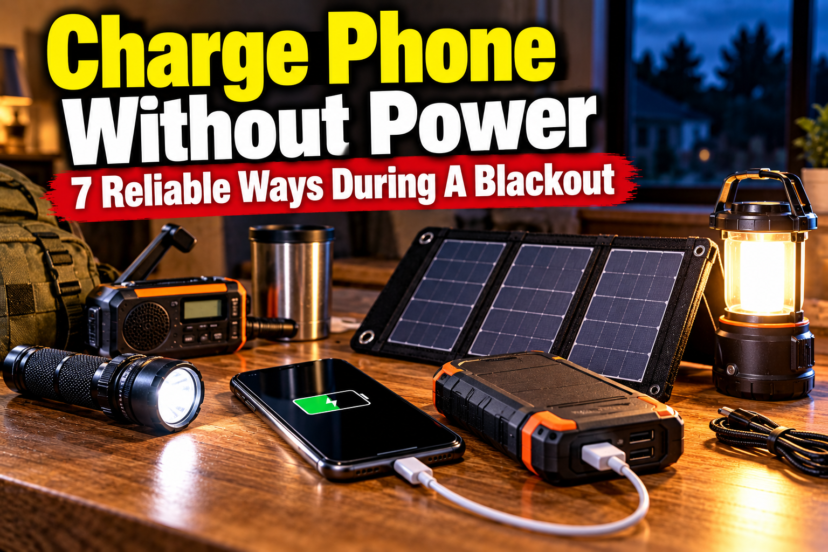
A charged power bank may solve the problem for a short outage. Vehicle charging, portable power stations, and solar panels can provide additional options when electricity remains unavailable.
The key is building several simple charging options before the lights go out.
🔋 Quick Answer: How To Charge Phone Without Power
The easiest way to charge phone without power is with a pre-charged USB power bank. During longer outages, other options include a portable power station, compatible solar charger, vehicle USB outlet or adapter, laptop battery, and certain hand-crank emergency devices. Start conserving your phone battery immediately, prioritize communication over entertainment, and use several backup charging methods rather than depending on one device.
Key Takeaways
Most likely cause: Hurricanes, winter storms, thunderstorms, wildfires, equipment failures, and grid disruptions can leave households without normal phone charging.
Usually serious? A dead phone is not always dangerous, but losing emergency alerts, communication, navigation, and access to important information can create problems during a serious outage.
First thing to check: Check your phone’s remaining battery and immediately reduce unnecessary power consumption.
Best solution: The simplest way to charge phone without power is to keep a charged power bank available, then add alternative options such as vehicle, solar, or portable power-station charging for longer outages.
⚡ 1. Use A USB Power Bank
For most families, a portable power bank is the simplest blackout charging solution.
You charge the battery pack ahead of time using normal household electricity. When the grid fails, plug your phone into the power bank.
No generator, fuel, or complicated setup is required.
Power banks are commonly measured in milliamp-hours, or mAh. A 10,000 mAh model can provide useful backup capacity for many smartphones, although the actual number of charges varies because of phone battery size, efficiency losses, battery condition, and other factors.
Larger 20,000 mAh units provide more capacity but are heavier.
If you want to charge phone without power during a multi-day emergency, consider keeping more than one power bank.
Store the correct cables with them.
A fully charged battery bank is useless if your USB-C or Lightning cable is sitting somewhere else.
☀️ 2. Use A Portable Solar Charger
Solar power becomes especially useful when an outage lasts long enough to drain your stored batteries.
A folding solar panel can use sunlight to recharge a power bank, which can then charge your phone.
This creates a simple cycle:
Sunlight → Solar Panel → Power Bank → Phone
Although some solar panels can charge phones directly, charging a battery bank first is often convenient because changing clouds and shade can cause solar output to fluctuate.
Do not expect a small portable panel to behave exactly like a wall outlet.
Actual solar production depends on panel size, sunlight, weather, temperature, angle, shade, and charging efficiency.
For emergency preparedness, use solar as one layer of your system rather than your only charging method.
Your solar charger for emergencies becomes particularly valuable when grid electricity may remain unavailable for several days.
🚗 3. Charge Your Phone From Your Vehicle
Your vehicle may provide another way to charge phone without power at home.
Many modern vehicles have USB ports. Older vehicles can often use an appropriate 12-volt USB adapter.
This can be helpful after hurricanes, ice storms, and other outages when your house has lost electricity, but roads and your vehicle remain accessible.
However, vehicle charging requires common-sense safety.
Never run a gasoline or diesel vehicle inside a closed garage or other enclosed space.
Carbon monoxide can accumulate and become deadly.
Move the vehicle outdoors into an appropriate open location before running the engine, and follow the vehicle manufacturer’s guidance.
Also be careful not to drain the vehicle’s starter battery by leaving accessories operating for extended periods with the engine off.
Your transportation may be essential during an evacuation, so preserve it.
🔌 4. Use A Portable Power Station
A portable power station is essentially a much larger rechargeable battery system.
Depending on the model, it may include USB-A, USB-C, 12-volt, and AC outputs.
That means it can potentially recharge phones along with flashlights, radios, tablets, laptops, and other compatible equipment.
Some larger systems can support certain appliances, although capacity and output requirements vary significantly.
You do not need a large power station simply to charge one smartphone.
But for a family preparing for extended outages, a portable power station can become the central battery in a broader emergency power plan.
It can often be recharged from household electricity before a storm and, depending on the model, replenished later through compatible solar panels or vehicle charging.
Check manufacturer specifications before connecting equipment.
💻 5. Use A Charged Laptop
If your laptop is fully charged when the electricity fails, its battery may provide another emergency source of power.
Connect your phone to an appropriate USB port if the laptop supports charging connected devices.
This is not the most efficient long-term solution because you are simply transferring stored energy from one battery to another.
However, during a short outage, that extra power may be exactly what you need to send messages or receive important updates.
If the laptop itself is not essential during the blackout, using part of its battery to keep your phone functioning may make sense.
When deciding how to charge phone without power, think about all the batteries already sitting around your home—not only dedicated emergency equipment.
📻 6. Consider A Hand-Crank Emergency Radio
Some emergency radios include USB charging outputs powered partly through a hand crank.
This sounds ideal, but expectations should be realistic.
Hand-cranking can require substantial effort to produce relatively modest amounts of energy. It generally should not be your primary method for fully charging a modern smartphone.
Instead, think of hand-crank phone charging as a last-resort backup.
It may provide enough energy for limited phone use when your other batteries have been exhausted.
The radio itself can still be valuable because it gives you another way to receive emergency information when cellular data, internet service, or household electricity is disrupted.
If you purchase one, test its charging feature before depending on it.
🔦 7. Conserve The Battery You Already Have
The easiest watt-hour to replace is the one you never used.
As soon as the electricity fails, start conserving your phone battery.
This can dramatically extend the time before you need another charging source.
Try these simple steps:
- Enable Low-Power Or Battery-Saver Mode
- Lower Screen Brightness
- Reduce Screen-On Time
- Turn Off Unnecessary Bluetooth
- Disable Unneeded Background Apps
- Avoid Streaming Video
- Limit Gaming And Entertainment
- Download Important Information In Advance
- Use Airplane Mode When You Do Not Need Connectivity
Cellular phones can sometimes consume additional power while searching for weak or unavailable signals.
If service disappears completely and you do not need an immediate connection, airplane mode can conserve power. Turn connectivity back on periodically when appropriate to check for service, messages, or alerts.
During a serious emergency, treat your phone as communication equipment rather than entertainment.
📱 Create A Family Phone-Charging Plan
One mistake during outages is allowing everyone to charge whenever they want.
Instead, think about your household’s available energy as a shared resource.
Perhaps one phone remains fully operational while others stay in low-power mode. Family members can check messages and emergency information at scheduled intervals rather than continuously refreshing apps.
If you have several power banks, label them.
For example:
Bank 1 – Phones
Bank 2 – Lights And Radio
Bank 3 – Reserve
This prevents your entire backup supply from disappearing during the first evening of a multi-day outage.
Your goal when you charge your phone without power is not necessarily maintaining 100% battery.
Keeping the phone functional when you need it is what matters.
🌀 Prepare Before Hurricanes And Winter Storms
When severe weather is forecast, use the grid while you still have it.
Charge:
- All Household Phones
- Power Banks
- Portable Power Stations
- Rechargeable Flashlights
- Emergency Radios
- Laptops
- Other Useful Battery Equipment
Do not wait until the wind is howling outside to discover that your power bank has 8% remaining.
Hurricane-prone households in Florida or along the Gulf Coast may want enough stored power for several days.
In areas vulnerable to winter storms, solar charging may be less dependable because of shorter daylight hours, clouds, or snow. Additional stored battery capacity may therefore be particularly valuable.
Your local risks should shape your charging plan.
🧰 Test Your Backup Charging Equipment
Emergency gear should work before it earns a place in your preparedness kit.
Test your power banks and cables.
Confirm your phone can charge from your vehicle.
Try your solar panel on a sunny day.
Learn how your portable power station operates.
Check rechargeable batteries according to manufacturer instructions and stop using battery packs that are swollen, damaged, leaking, unusually hot, or otherwise abnormal.
A simple test can uncover surprisingly common problems:
The wrong cable.
A dead battery bank.
A broken USB port.
An adapter that does not fit your phone.
Solve those problems today rather than during the next blackout.
⚠️ When To Consult A Professional Or Follow Official Guidance
Phone charging itself is generally simple, but the emergency surrounding the outage may not be.
Contact your utility or a licensed electrician if you encounter damaged electrical equipment, repeated breaker problems, sparking, burning odors, or flooding near electrical systems.
Never approach downed power lines.
Follow official emergency management guidance during hurricanes, wildfires, floods, winter storms, evacuations, and prolonged outages.
Fuel-powered generators and vehicles produce carbon monoxide and should never be operated in enclosed or improperly ventilated spaces.
If someone relies on electrically powered medical equipment, develop a dedicated backup-power plan with appropriate healthcare professionals, equipment providers, utilities, and emergency resources rather than relying on a smartphone power bank.
❓ Frequently Asked Questions
How Can I Charge My Phone When The Power Is Out?
Use a charged USB power bank, portable power station, compatible solar panel, vehicle USB outlet, or another safe source of stored electricity. A power bank is usually the simplest option for short outages.
How Can I Charge My Phone Without Electricity Or A Power Bank?
Possible alternatives include solar charging, a properly used vehicle charging port, a charged laptop, or certain hand-crank emergency devices. Availability and charging speed vary.
Can A Solar Panel Charge My Phone?
Yes, compatible portable solar panels can charge phones or power banks. Performance depends on sunlight, panel capacity, weather, shade, and the device’s charging requirements.
Can I Charge My Phone From My Car During A Power Outage?
Yes, if your vehicle has a compatible USB outlet or adapter. Never run a fuel-powered vehicle inside a garage or other enclosed space because of carbon monoxide danger.
How Long Does A 10,000 mAh Power Bank Last?
It depends on the phone battery capacity and charging efficiency. A 10,000 mAh power bank may provide multiple partial or full phone charges, but you should not assume its rated capacity transfers completely to the phone.
Should I Keep My Phone At 100% During A Blackout?
Not necessarily. The goal is maintaining enough battery for communication and important information. Conserving power and recharging strategically can make limited backup energy last longer.
What Is The Best Emergency Backup For Charging A Phone?
For most households, start with one or more charged power banks. For longer outages, add another replenishment method such as a portable solar panel, vehicle charging option, or portable power station.
🏡 A Charged Phone Is Part Of A Bigger Preparedness Plan
Learning how to charge phone without power is a simple preparedness skill, but it can make a major difference during an extended blackout.
You do not need to buy everything at once.
Start with a reliable power bank and the correct charging cable. Keep both charged and somewhere easy to find.
Then build redundancy.
Add a vehicle adapter. Consider a folding solar panel. If extended outages are common where you live, a portable power station may eventually make sense.
Most importantly, learn to conserve the battery you already have.
Preparedness is not about having unlimited electricity when the grid goes down. It is about having enough options to keep the devices that matter working when you need them.
A little planning today means that when the next hurricane, winter storm, wildfire, or neighborhood blackout arrives, a 20% phone battery does not have to become another emergency.
Disclaimer: This article is for general educational and preparedness purposes only. Emergency conditions, individual needs, regional regulations, equipment requirements, and local hazards vary. Always follow local laws, official emergency and utility guidance, vehicle and equipment manufacturer instructions, and applicable safety requirements. Seek qualified professional guidance for electrical systems, medical power requirements, or situations involving significant safety risks.
Explore more:
- First Hour Blackout Survival: What To Do
- Refrigerator During Power Outage
- Best Emergency Flashlight: What To Look For