Solar Charger For Emergencies: How To Keep Phones And Essential Devices Powered
Solar Chargers For Emergency Use
When the power goes out for a few hours, a charged phone may be all you need. But when a hurricane, winter storm, wildfire, or widespread grid failure knocks out electricity for a day or longer, keeping essential devices powered becomes much harder. That is where a solar charger for emergencies can become a valuable part of a practical preparedness plan.
Solar charging will not replace your home electrical system, and a small panel will not magically run every appliance you own. What it can do is give you another way to recharge phones, power banks, radios, flashlights, and other small devices when wall outlets are unavailable.
For everyday families, that extra option can provide meaningful peace of mind.
You do not need an elaborate off-grid solar system, either. A modest folding solar panel combined with a dependable power bank can create a simple emergency charging setup that is affordable, portable, and easy to store.
☀️ Quick Answer: Is A Solar Charger For Emergencies Worth Having?
A solar charger for emergencies can be worth having as a backup way to recharge phones, power banks, radios, lights, and other small USB devices during extended power outages. For most families, a folding solar panel paired with a separate battery bank is more practical than relying on a tiny solar power bank alone. Choose equipment based on realistic power needs, test it before an emergency, and remember that charging speed depends heavily on sunlight and weather.
Key Takeaways
Most likely cause: Hurricanes, winter storms, severe thunderstorms, wildfires, utility failures, and other emergencies can interrupt normal charging for hours or days.
Usually serious? A dead phone is not automatically an emergency, but losing access to communication, alerts, navigation, lighting, or other essential devices can make a difficult situation harder.
First thing to check: Identify which devices actually need power and how much battery capacity you already have available.
Best solution: Use a properly sized solar charger for emergencies with one or more power banks, appropriate cables, and a realistic plan for conserving electricity during extended outages.
🔋 Why Solar Charging Can Improve Emergency Preparedness
Most household emergency plans depend heavily on electricity without realizing it.
Consider what happens during a blackout.
You may use your smartphone to receive emergency alerts, contact family, check weather forecasts, follow evacuation information, access maps, or communicate with your utility company.
Rechargeable flashlights, headlamps, weather radios, tablets, and battery-powered fans may also need charging.
Power banks solve this problem temporarily. Eventually, however, they run out.
A solar charger for emergencies adds another layer of redundancy because sunlight can potentially replenish those batteries even while the electrical grid remains unavailable.
That does not mean solar charging should be your only plan.
Think of it as another tool in a layered preparedness system:
Grid Power → Charged Power Banks → Vehicle Charging → Solar Charging
If one option becomes unavailable, you still have alternatives.
⚡ Understand Watts Before Buying A Solar Charger
Solar panels are commonly advertised according to wattage.
A compact panel might be rated at 10 or 20 watts, while larger folding models may be rated at 50, 100 watts, or more.
The advertised rating represents performance under favorable conditions. Real-world output can be lower because of clouds, panel angle, temperature, shade, conversion losses, and other factors.
For basic phone and power-bank charging, a portable panel in roughly the 20- to 30-watt range can provide a useful starting point for many people.
Families wanting to recharge larger power stations may need substantially more solar capacity.
The best solar charger for emergencies is not automatically the largest panel you can afford.
Ask what you actually want to power.
If your goal is simply maintaining two phones and a USB flashlight, you probably do not need the same setup as someone trying to operate a portable refrigerator and a large battery station.
🔌 Use A Solar Panel With A Power Bank
One of the most useful emergency setups separates solar collection from battery storage.
The solar panel collects energy during daylight and charges a power bank. You can then use that stored energy whenever you need it.
This offers several advantages.
You do not have to leave your smartphone sitting outside in direct sunlight. You can also store solar energy during the day and recharge devices after sunset.
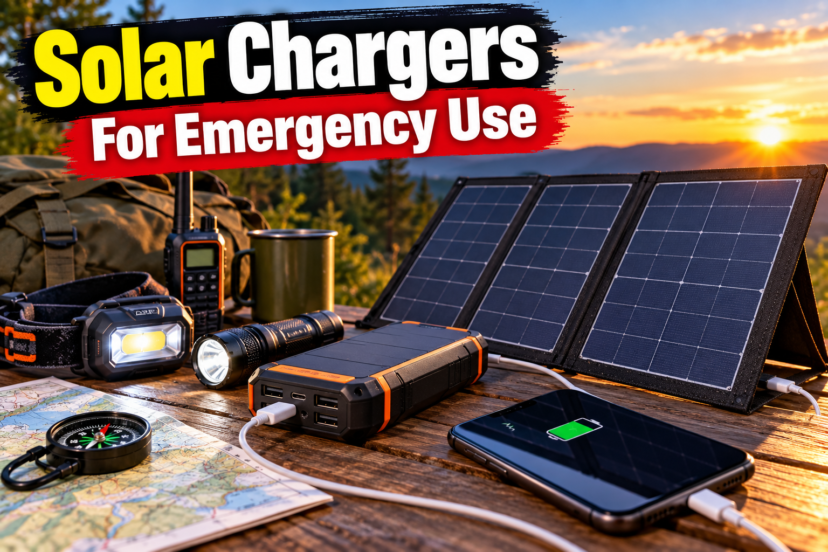
A practical setup could include:
- One Folding Solar Panel
- One Or Two USB Power Banks
- Short Charging Cables
- Backup Cables
- Appropriate Charging Adapters
- Waterproof Storage Bag
Keep compatible equipment together so you are not hunting for a missing cable during a blackout.
Before hurricane or winter-storm season, charge every battery bank from the electrical grid. Solar should generally begin as your backup replenishment method, not your starting point.
🌤️ Understand The Limitations Of Solar Charging
Solar charging is useful, but expectations matter.
A panel advertised at a certain wattage will not necessarily deliver that output throughout the entire day.
Clouds can reduce production. Shade from a tree, balcony, building, or even a small obstruction can significantly affect some panels.
The sun’s angle also changes.
That means a solar charger for emergencies should not be treated like an outdoor wall outlet.
You may need several hours of good sunlight to replenish a power bank.
Winter can present additional challenges because daylight hours are shorter and the sun may be lower in the sky.
The solution is simple: build extra capacity into your emergency plan.
Begin an outage with your power banks already charged, conserve electricity, and use solar energy to extend your available stored power rather than expecting it to supply unlimited energy.
📱 Prioritize Essential Devices During A Blackout
Energy conservation is just as important as energy production.
During a prolonged outage, decide what deserves power.
A smartphone used for emergency communication is usually more important than streaming video on a tablet.
Your priority list might look something like this:
- Phones Used For Communication And Alerts
- Essential Medical Or Safety Devices Where Appropriate
- Emergency Radio
- Rechargeable Flashlights And Headlamps
- Small Battery-Powered Fans
- Nonessential Entertainment Devices
Turn on your phone’s battery-saving mode and reduce screen brightness.
Download useful maps and emergency information before severe weather arrives when possible.
A solar charger for emergencies becomes far more effective when you are not wasting the electricity it produces.
🔋 Solar Power Bank Vs Folding Solar Panel
You have probably seen compact power banks with a small solar panel built directly into the case.
They look ideal for emergencies.
The problem is surface area.
A very small solar panel can collect only a limited amount of energy, which means recharging a large internal battery entirely from sunlight may be very slow.
These devices can still be useful as ordinary battery banks, but do not assume the tiny built-in panel will quickly recharge the battery after it is depleted.
For more dependable emergency solar charging, a larger folding panel paired with a separate power bank is often a more practical approach.
The panel provides substantially more collection area while the battery stores the energy for later use.
🎒 Choose Features That Match Real Emergencies
When shopping for a solar charger for emergencies, ignore unnecessary features and concentrate on practical ones.
Useful Features To Consider
Adequate Wattage: Match panel capacity to the devices or battery station you intend to recharge.
USB-C Support: Many modern phones, power banks, and other devices use USB-C.
Multiple Outputs: Helpful when several family members need charging.
Portable Design: Folding panels are easier to store in apartments, vehicles, and emergency kits.
Weather Resistance: Outdoor equipment should tolerate the conditions described by its manufacturer, although weather-resistant does not necessarily mean waterproof.
Strong Attachment Points: Loops or stands can make positioning the panel easier.
Also check weight and packed dimensions.
A 100-watt panel may sound better than a 20-watt panel, but not if your main goal is a lightweight evacuation kit.
🏙️ How To Use Solar Chargers In An Apartment
Urban preparedness creates a special challenge: sunlight.
Apartment residents may not have a backyard where they can place a solar panel all day.
Before depending on solar, determine where direct sunlight actually reaches your property.
A balcony may work well in some buildings. A shaded north-facing apartment may provide very limited options.
Do not place equipment on ledges where it could fall, create hazards for people below, or violate building rules.
And remember that glass can affect solar-panel performance. A panel sitting behind a window may not perform as well as one positioned properly outdoors.
Test your solar charger for emergencies at home before assuming it will meet your needs.
That test is free—and can reveal weaknesses in your plan while electricity is still available.
🌪️ Build Your Solar Plan Around Your Regional Risks
Different U.S. emergencies create different charging challenges.
Florida and Gulf Coast households preparing for hurricanes may need several days of backup power after a major storm.
Western families may want portable solar charging as part of wildfire evacuation preparedness or extended utility shutoffs.
In northern states, winter outages introduce shorter daylight hours and potentially heavy cloud cover or snow.
People living in tornado- and thunderstorm-prone regions may be more concerned about sudden outages with little advance warning.
A solar charger for emergencies works best as part of a broader system that includes fully charged batteries, flashlights, shelf-stable food, water, a weather radio, and a household emergency plan.
🧰 Test Your Emergency Solar Setup Before You Need It
Never let an emergency be the first time you unfold your solar panel.
On a sunny weekend, test the entire setup.
Charge a partially depleted power bank. See where the panel performs best. Confirm your cables work. Learn how long charging actually takes.
This gives you realistic expectations.
Periodically inspect power banks for swelling, unusual heat, damage, or other problems, and follow manufacturer guidance for charging and storage.
Lithium-ion batteries should be treated carefully. Do not use damaged or swollen batteries.
A simple test once or twice a year can make your emergency solar system much more dependable.
⚠️ When To Consult A Professional Or Follow Official Guidance
Small USB solar chargers are generally straightforward, but larger emergency power systems can involve electrical risks.
If you are considering permanently installed solar equipment, home battery storage, generator connections, or equipment tied into household circuits, consult appropriately qualified professionals and follow local electrical codes.
Never improvise connections to your home’s wiring.
During hurricanes, wildfires, floods, or other serious disasters, follow instructions from emergency management agencies and utility providers.
People who rely on electrically powered medical equipment should develop a backup-power plan with their healthcare provider and other appropriate professionals rather than depending solely on a consumer solar charger.
❓ Frequently Asked Questions
What Is The Best Solar Charger For Emergencies?
For many households, a folding solar panel paired with a separate power bank provides a flexible solution. Look for adequate wattage, useful USB outputs, portability, durability, and compatibility with the devices you need to charge.
How Many Watts Should An Emergency Solar Charger Have?
Around 20–30 watts can be useful for phones and smaller power banks under favorable conditions. Larger power stations and higher energy demands generally require more solar capacity.
Can A Solar Charger Charge A Phone Directly?
Many portable panels can charge compatible phones directly, but charging can become inconsistent when sunlight changes. Charging a power bank first can provide more stable stored energy for your phone.
Do Solar Chargers Work On Cloudy Days?
Solar panels can still produce electricity under some cloudy conditions, but output may be substantially lower than in strong direct sunlight. Never base an emergency power plan on advertised maximum output alone.
Are Solar Power Banks Good For Emergencies?
They can be useful as battery banks, but models with very small built-in solar panels may recharge extremely slowly from sunlight. A separate folding panel usually provides much more solar collection area.
Can A Solar Charger Power A Refrigerator?
Small portable USB solar chargers generally cannot directly operate a household refrigerator. Running larger appliances typically requires an appropriately sized solar array, battery storage system, inverter, and other compatible equipment.
Should I Buy A Solar Charger Or A Power Bank For Emergencies?
Ideally, use both. A power bank gives you electricity immediately, while a solar panel gives you a way to potentially replenish that stored energy during a longer outage.
🏡 Small Steps Toward Greater Energy Independence
A solar charger for emergencies will not make your home completely energy independent—and it does not need to. Its purpose is much simpler.
It gives you one more way to keep essential devices operating when the electrical grid is unavailable.
Start with what you can afford. Keep your phone charged. Add a dependable power bank. Then consider a modest folding solar panel that can replenish your stored power during an extended outage.
Test everything before you need it.
Preparedness is rarely about buying one piece of equipment that solves every problem. It is about creating layers of practical options so one failure does not leave your family without a plan.
Every small improvement gives you a little more control, a little more confidence, and a little more peace of mind when normal systems stop working.
That is what practical self-reliance is really about.
Disclaimer: This article is for general educational and preparedness purposes only. Emergency conditions, individual needs, regional regulations, and equipment requirements vary. Always follow local laws, official emergency guidance, utility instructions, applicable electrical codes, and manufacturer instructions. Seek qualified professional guidance for home electrical systems, medical power requirements, or situations involving significant safety risks.
Explore more:
- Bottled Water Vs Water Storage Containers
- Best Portable Power Station For Home Emergencies
- Best Generator Safety Tips: 12 Rules