Best Portable Power Station For Home Emergencies: 7 Things To Look For Before You Buy
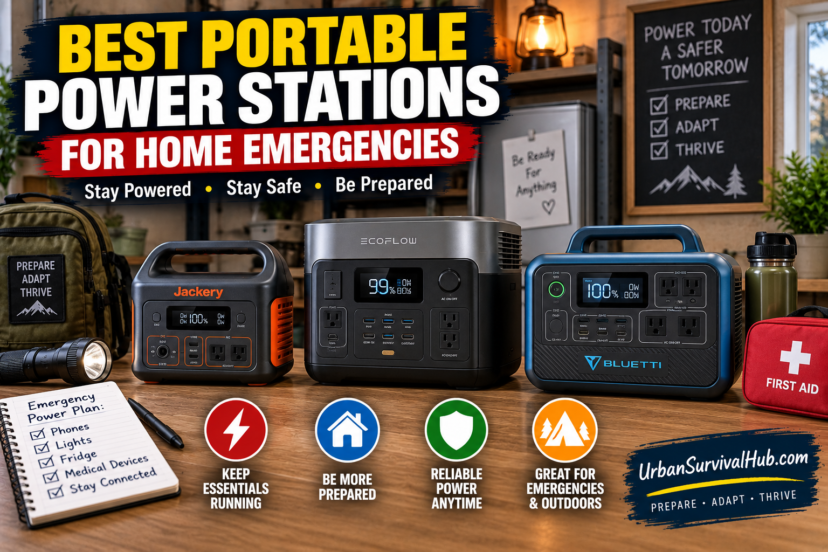
A power outage can turn everyday conveniences into immediate problems. Your refrigerator stops cooling, phones begin losing charge, lights go dark, and important devices may suddenly become harder to use. That is why choosing the best portable power station can be a practical part of a modern household emergency plan.
Unlike gasoline generators, portable power stations store electricity in rechargeable batteries and can operate without burning fuel while in use. That makes them useful for apartments, townhomes, and houses where running a traditional generator may be impractical.
But bigger and more expensive does not automatically mean better. The right unit depends on what you actually need to power, how long an outage might last, and how you plan to recharge it. Understanding a few basic specifications can help you prepare for hurricanes, winter storms, wildfires, and grid outages without buying more equipment than your family needs.
⚡ Quick Answer: What Is The Best Portable Power Station?
The best portable power station for home emergencies has enough battery capacity and output to run your essential devices safely, along with multiple charging options and useful AC, USB, and DC ports. For basic phones, lights, and electronics, a smaller unit may be enough. Refrigerators and longer outages generally require substantially more battery capacity and output.
Key Takeaways
Most likely cause: Families often buy the wrong emergency power station because they focus on price or advertised capacity without calculating what they actually need to run.
Usually serious? Not necessarily, but insufficient power can become a major inconvenience during an extended outage, especially when refrigeration, communications, lighting, or important equipment is needed.
First thing to check: List the essential devices you want to power and check their running watts, startup requirements, and estimated daily energy consumption.
Best solution: The best portable power station is one sized around your real emergency loads, with adequate battery capacity, safe output, suitable ports, reliable recharging options, and room for unexpected needs.
🔋 Why Portable Power Stations Are Useful During Emergencies
Portable power stations essentially provide a rechargeable reserve of electricity.
You charge the battery ahead of time using an appropriate source, then use its outlets and ports to power compatible devices when normal electricity is unavailable.
Depending on capacity and output, a power station may help operate:
- Smartphones
- Tablets
- LED Lights
- Laptops
- Internet Equipment
- Radios
- Fans
- CPAP Machines, Subject To Manufacturer Guidance
- Small Appliances
- Refrigerators Or Freezers On Appropriately Sized Units
One of their biggest advantages is flexibility.
There is no gasoline to store for normal battery operation, and there is no engine producing exhaust while the unit is supplying power.
That makes battery power stations particularly useful for urban households.
🏠 Portable Power Station Vs Traditional Generator
Both systems can play valuable roles, but they solve different problems.
A fuel-powered generator can often deliver considerably more continuous power and may run as long as fuel remains available. However, generators produce dangerous exhaust gases, including carbon monoxide, and must be operated outdoors at a safe distance from buildings according to manufacturer and official safety instructions.
Portable battery stations are quieter and simpler to operate. They can power compatible equipment indoors because the battery itself does not create combustion exhaust during use.
However, once the battery is depleted, it must be recharged.
That makes the best portable power station particularly attractive for shorter outages, apartments, overnight use, communication equipment, and situations where quiet backup power is important.
Some households may ultimately benefit from having both battery backup and a properly operated generator.
📊 1. Choose The Right Battery Capacity
Battery capacity is commonly measured in watt-hours, abbreviated Wh.
Think of watt-hours as the size of your electrical fuel tank.
A 1,000Wh battery theoretically stores about 1,000 watt-hours of energy, although the amount available to your appliances will normally be lower because of inverter losses, operating conditions, temperature, and other factors.
Portable stations commonly fall into broad ranges such as:
250–500Wh
Useful for phones, LED lighting, tablets, laptops, radios, and other relatively low-power electronics.
500–1,000Wh
Provides more flexibility for communication equipment, fans, electronics, and some limited appliance use.
1,000–2,000Wh
A popular range for more serious household backup because appropriately rated models may support refrigerators, electronics, lighting, and other essentials for longer periods.
2,000Wh And Above
Higher-capacity units can support larger emergency loads or longer runtimes, although they become heavier and more expensive.
The best portable power station is not necessarily the largest one you can afford. It is the one that provides enough capacity for your priority devices.
⚙️ 2. Understand Running Watts And Surge Watts
Capacity tells you how much energy the battery stores.
Power output tells you how much equipment it can operate at once.
These are different specifications.
For example, an appliance may draw a certain amount of power while operating but briefly require significantly more electricity when its motor starts.
Refrigerators, freezers, pumps, and some power tools may have these startup surges.
Before connecting an appliance, compare its requirements with the power station’s:
- Continuous AC Output
- Surge Or Peak Output
- Individual Outlet Limits
- Total Output Limits
Do not assume a large battery automatically means the inverter can run every appliance.
Always follow both appliance and power-station manufacturer specifications.
🧮 3. Calculate How Long Your Essential Devices Could Run
Runtime estimates help prevent disappointment during an actual outage.
A simple planning example illustrates why.
Suppose you have a 1,000Wh portable power station and want to run a device drawing 50 watts continuously.
Ignoring losses, that would suggest about 20 hours of operation.
In real life, runtime will generally be shorter because the system itself consumes some energy and conversion is not perfectly efficient.
Refrigerators are more complicated because compressors cycle on and off rather than drawing their rated running power continuously.
Instead of relying entirely on advertised examples, identify the devices you care about most and estimate their energy use.
This makes choosing the best portable power station much easier.
🔌 4. Check The Number And Type Of Outlets
Battery capacity gets most of the attention, but ports matter too.
A useful emergency station may include:
- Standard AC Outlets
- USB-A Ports
- USB-C Ports
- 12-Volt DC Output
- High-Power USB-C Charging
- Appropriate Specialty Outputs
Think about your family’s normal devices.
Modern phones, tablets, and laptops increasingly use USB-C. Older equipment may use USB-A. Household appliances generally require AC outlets.
Having multiple connection options can reduce the number of adapters you need during an outage.
Avoid overloading outlets or using unsafe extension-cord arrangements. Follow the power station’s rated limits and instructions.
☀️ 5. Consider Solar Charging
Solar charging can make a portable battery much more useful during a prolonged grid outage.
Many modern power stations can connect to compatible portable solar panels.
During a multi-day hurricane or widespread grid failure, solar panels may allow you to replenish part of the energy you consume each day.
However, solar charging is not unlimited free electricity.
Actual output depends on:
- Panel Wattage
- Sunlight
- Weather
- Shade
- Panel Angle
- Season
- Charging-System Limits
A panel advertised at 200 watts will not necessarily produce 200 watts throughout the entire day.
When comparing options for the best portable power station, check the maximum solar input and compatible voltage/current range rather than assuming any solar panel will work.
🔋 6. Look At Battery Chemistry And Cycle Life
Battery chemistry can affect weight, lifespan, safety characteristics, and price.
Many newer portable power stations use lithium iron phosphate batteries, commonly abbreviated LiFePO4 or LFP.
These batteries have become popular partly because they can offer long cycle life and good thermal stability.
Other portable stations use different lithium-ion chemistries that may provide advantages such as lower weight.
Cycle-life claims should be read carefully.
Manufacturers may describe lifespan as the number of charging cycles until the battery retains a certain percentage of its original capacity.
For emergency preparedness, a long cycle life can be valuable if you also plan to use the station regularly for camping, outdoor work, or everyday backup.
🛡️ 7. Prioritize Safety And Useful Emergency Features
The best portable power station should do more than store electricity.
Look for practical safety and emergency features such as:
- Battery Management Systems
- Overload Protection
- Over-Temperature Protection
- Short-Circuit Protection
- Clear Battery-Level Display
- Low-Battery Warnings
- Built-In Lighting When Useful
- Reliable Handles Or Wheels On Larger Units
Also consider product support, warranty coverage, and availability of compatible replacement accessories.
A cheap battery with unclear specifications and limited support may not be a bargain if you are depending on it during an emergency.
💰 How Much Portable Power Station Capacity Do You Really Need?
You can avoid overspending by dividing household loads into priorities.
Priority 1: Communication And Lighting
Phones, flashlights, radios, small LED lamps, and basic electronics require relatively little energy.
A smaller unit may be sufficient.
Priority 2: Comfort And Connectivity
Add laptops, fans, internet equipment, and additional electronics, and your required capacity increases.
Priority 3: Refrigeration
Keeping food cold can significantly increase emergency power needs. Check the actual refrigerator’s requirements and account for startup power and cycling.
Priority 4: Larger Essential Loads
Medical equipment, pumps, heating equipment, or other critical systems require careful planning and may exceed what smaller portable stations can reliably support.
Buying based on priorities makes the best portable power station easier to identify than simply shopping by the biggest Wh number.
❄️ Using A Portable Power Station During Winter Storms
Winter outages create special challenges.
Batteries can perform differently in very cold conditions, so storage and operating temperature limits matter.
Keep your unit within the manufacturer’s recommended temperature range.
During an outage, prioritize energy carefully.
Instead of trying to electrically heat an entire home with a portable battery—which can drain even a large unit rapidly—focus on communication, lighting, refrigeration when necessary, and other essential low-to-moderate loads.
Follow local emergency guidance regarding safe heating during severe winter weather.
Never use fuel-burning appliances indoors unless they are specifically designed, installed, and approved for that use.
🌀 Portable Power Stations For Hurricanes And Wildfires
In hurricane-prone states such as Florida, Louisiana, and Texas, a power station can provide useful backup electricity before utility crews restore the grid.
Charge it fully before the storm arrives.
If compatible solar panels are part of your plan, test the entire charging system before hurricane season.
Wildfire preparedness is different because evacuation may become the priority.
A smaller portable power station can help keep phones, radios, laptops, and other communication equipment charged if you need to leave quickly.
Larger units may provide more energy, but portability matters.
Emergency equipment should support your evacuation plan, not slow it down.
🏙️ Best Portable Power Station Strategy For Apartments
Battery stations are especially attractive for apartments because traditional generator use is often impractical or unsafe.
You may not need a massive unit.
A moderate-capacity power station paired with efficient devices can support essential communication, lighting, and limited electronics without occupying much space.
Apartment residents can build preparedness gradually:
- Buy A Reliable Power Station Sized For Essential Loads.
- Keep LED Lighting And USB Charging Cables With It.
- Charge And Check The Unit Regularly.
- Consider Compatible Solar Charging If You Have A Safe, Practical Location To Use It.
- Keep A Separate Supply Of Flashlights And Batteries.
Redundancy creates resilience.
⚠️ Common Portable Power Station Mistakes
Even the best portable power station will disappoint if it is used incorrectly.
Avoid these common mistakes:
- Buying Based Only On Battery Capacity
- Ignoring Continuous Output
- Forgetting Appliance Startup Surge
- Assuming Advertised Runtime Matches Every Situation
- Letting The Battery Sit Unchecked For Long Periods
- Using Incompatible Solar Panels
- Overloading Outlets
- Expecting A Small Unit To Power An Entire House
- Waiting Until The Outage To Learn How It Works
Test your emergency setup before you need it.
Plug in the devices you expect to use and see how quickly the battery percentage changes.
A simple practice run can reveal problems while the grid is still working.
👷 When To Consult A Professional
Some backup-power situations require qualified guidance.
Consult a licensed electrician before connecting any portable power source to household wiring, transfer equipment, electrical panels, or circuits. Never improvise a connection intended to energize household wiring.
For critical medical devices, speak with the equipment manufacturer and appropriate medical professionals about backup-power requirements and emergency planning rather than relying on general runtime estimates.
During hurricanes, wildfires, floods, winter storms, or other severe disasters, follow instructions from local emergency management agencies and utilities.
If equipment becomes damaged, overheats, swells, smells unusual, gets wet when not designed for it, or otherwise appears unsafe, stop using it and follow manufacturer safety instructions.
❓ FAQs: Best Portable Power Station
What Size Portable Power Station Is Best For Home Emergencies?
For basic phones, lights, laptops, and communication equipment, several hundred watt-hours may be sufficient. Families wanting to support refrigeration and more demanding devices may prefer 1,000Wh or more. Calculate your actual loads before choosing.
Can A Portable Power Station Run A Refrigerator?
Many appropriately sized power stations can run certain refrigerators, but the station must handle both the refrigerator’s running power and startup surge. Runtime depends on battery capacity, refrigerator efficiency, room temperature, compressor cycling, and other factors.
Is A 1,000W Portable Power Station Enough?
A 1,000-watt output rating may be enough for many basic emergency loads, but watts describe output rather than battery capacity. Also check the unit’s watt-hours and surge rating to understand what it can run and for how long.
How Long Will A Portable Power Station Last During An Outage?
Runtime can range from hours to days depending on battery capacity and connected loads. Charging only phones and lights consumes far less energy than running a refrigerator, fan, or other appliance.
Can You Use A Portable Power Station Indoors?
Battery power stations do not produce combustion exhaust while operating like gasoline generators do, making them suitable for many indoor applications when used according to manufacturer instructions. They should still be kept dry, adequately ventilated as directed, and away from excessive heat or damage.
Can Solar Panels Recharge A Portable Power Station During A Blackout?
Many models support compatible solar charging. Actual charging speed depends on panel output, sunlight, weather, positioning, and the station’s solar-input limits. Verify compatibility before connecting panels.
Is A Portable Power Station Better Than A Generator?
It depends on your needs. Battery stations are quiet, portable, and convenient for smaller emergency loads, while fuel-powered generators may provide substantially more continuous energy for larger loads. Some households benefit from incorporating both into a layered backup-power plan.
🏡 Final Thoughts: Build Backup Power Around What Your Family Actually Needs
The best portable power station is not automatically the biggest or most expensive model.
It is the one that keeps your family’s most important devices working when the grid does not.
Start by listing your priorities.
Maybe you need phones, LED lights, and a radio. Perhaps refrigeration is important. You might also want enough capacity for a fan, laptop, internet equipment, or another essential device.
Calculate those needs before spending money.
Then choose a power station with enough capacity and output, suitable ports, reliable charging options, appropriate safety features, and some extra headroom.
Most importantly, learn how to use it before an emergency.
Charge it. Test your essential devices. Learn how long they actually run. Check the battery periodically.
Preparedness doesn’t require powering your entire home exactly as you would on a normal day. It means protecting the things that matter most until normal services return.
One carefully chosen backup battery can give your family more options, greater self-reliance, and valuable peace of mind during the next power outage.
Preparedness And Safety Disclaimer: This article is for general educational and preparedness purposes only. Electrical needs, equipment specifications, medical requirements, emergencies, and regional regulations vary. Always follow local laws, official emergency and utility guidance, appliance and power-station manufacturer instructions, and advice from qualified professionals when applicable.
Explore more:
- Bottled Water Vs Water Storage Containers
- Best Water Storage Containers For Long-Term Storage
- Family Emergency Water Supply: How Much Water