Best Water Storage Containers For Long-Term Storage: 9 Smart Options For Emergency Preparedness
When the water stops flowing, even a well-stocked home can become uncomfortable surprisingly fast. Hurricanes, winter storms, wildfires, broken water mains, contamination events, and long power outages can all interrupt access to safe drinking water. That is why choosing the best water storage containers is one of the smartest and most affordable steps you can take to improve emergency preparedness.
You do not need a bunker, expensive equipment, or years of survival training to build a dependable household water supply. A few properly selected containers, stored in the right location and maintained correctly, can give your family valuable breathing room when normal services are disrupted.
The goal is not to prepare for every possible disaster. It is to create a realistic backup system that helps you stay calm, protect your family, and handle the first several days of an emergency with greater confidence and independence.
💧 Quick Answer: What Are The Best Water Storage Containers?
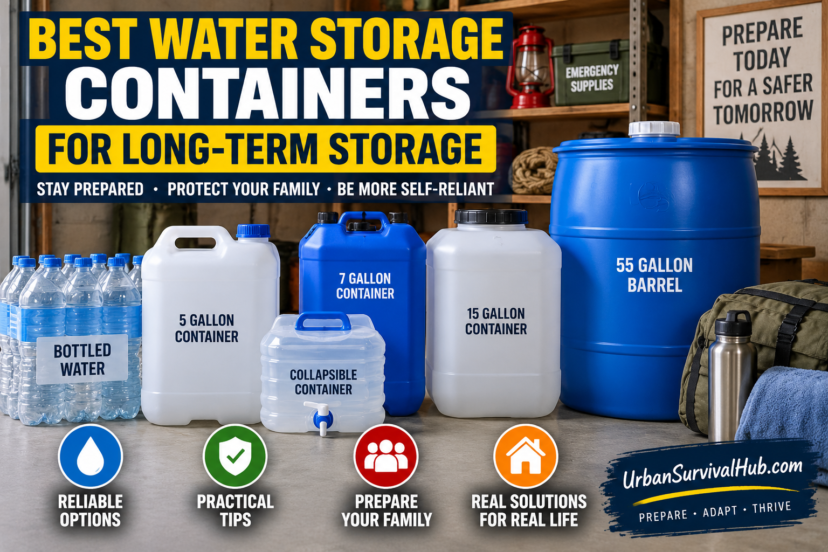
The best water storage containers are food-grade, durable, tightly sealable, easy to clean, and designed specifically for potable water. For most families, a mix of smaller 5- to 7-gallon containers and larger 15- to 55-gallon storage tanks works well. Smaller containers are easier to move, while larger containers provide more capacity for extended emergencies.
Key Takeaways
Most likely cause: Many families struggle with water preparedness because they either store too little water or use containers that were never designed for long-term potable water storage.
Usually serious? It can be. During an extended outage, contamination event, hurricane, or winter storm, unsuitable containers may leak, become difficult to move, or compromise water quality.
First thing to check: Confirm that your current containers are food-grade, clean, tightly sealed, and designed for drinking water storage.
Best solution: The best water storage containers combine safe materials, practical capacity, strong closures, easy handling, and storage conditions that protect water from heat, chemicals, and damage.
🏠 Why Choosing The Right Water Container Matters
Water preparedness is not only about how many gallons you store. The container itself matters.
A poor container can crack, leak, absorb odors, become difficult to clean, or expose stored water to contamination.
The right container makes emergency water storage simpler and more dependable.
Good containers should be:
- Food-Grade
- Strong And Durable
- Designed For Potable Water
- Easy To Seal
- Easy To Clean
- Practical To Move Or Dispense From
- Appropriate For Your Available Storage Space
The best water storage containers also match your household situation. A family living in a suburban home with a garage may have room for a 55-gallon drum, while someone in an apartment may need several smaller containers tucked into closets or under sturdy shelving.
There is no single perfect container for everyone.
🚰 1. Commercially Bottled Water
Commercial bottled water is one of the easiest ways to begin emergency water storage.
It requires almost no preparation. The water is already sealed in containers designed for drinking, and cases can be purchased gradually during normal grocery trips.
Best For
- Beginners
- Apartment Residents
- Short-Term Emergency Kits
- Evacuation Supplies
- Families Building A Starter Supply
Advantages
Commercial bottled water is easy to rotate and simple to distribute among family members.
The downside is that thin disposable bottles are not always ideal for very long storage periods, especially in hot garages or areas exposed to sunlight.
Check packaging condition regularly and follow manufacturer storage recommendations.
🪣 2. Five-Gallon Food-Grade Water Containers
For many households, 5-gallon containers offer one of the best balances between capacity and portability.
A full 5-gallon container weighs more than 40 pounds, but it is still much easier to move than a large water barrel.
These containers are useful for both home storage and evacuation planning.
Why They Work Well
They can be:
- Stacked Or Organized Efficiently
- Carried By One Strong Adult
- Filled Individually
- Rotated More Easily
- Stored In Closets, Garages, Or Utility Areas
For families looking for the best water storage containers without committing to a huge tank, 5-gallon containers are an excellent place to start.
🧴 3. Seven-Gallon Water Jugs
Seven-gallon jugs are popular among campers, RV owners, and preparedness-minded households.
They provide more capacity than a 5-gallon container while remaining relatively portable.
However, remember that water is heavy. Seven gallons can weigh close to 60 pounds once the container itself is included.
That means handles and overall construction quality matter.
Look for:
- Strong Molded Handles
- Leak-Resistant Caps
- Food-Grade Materials
- Stable Shapes
- Easy-Pour Spouts
These containers work especially well when you want portable storage but also want to reduce the total number of individual containers in your supply.
🛢️ 4. Fifteen-To-Twenty-Gallon Water Containers
Medium-size containers offer a useful compromise between portable jugs and large barrels.
They are ideal for households that want a more serious water reserve without dedicating enough room for several 55-gallon drums.
A 15-gallon water container weighs well over 100 pounds when full, so it should generally be positioned before filling.
This size works well in garages, basements, utility rooms, or protected storage areas.
A pump, spigot, or siphon system can make accessing the water much easier.
🛢️ 5. Fifty-Five-Gallon Water Barrels
For long-term preparedness, 55-gallon food-grade barrels are among the most popular options.
One barrel can hold a significant amount of emergency water without taking up excessive floor space.
For a family of four using one gallon per person per day as a planning baseline, 55 gallons represents roughly two weeks of basic water needs.
That makes large barrels appealing for hurricanes, earthquakes, major winter storms, or extended utility disruptions.
Important Limitation
A full 55-gallon barrel weighs more than 450 pounds.
Once filled, it is essentially stationary.
Before filling one, choose the location carefully and make sure the floor can safely support the weight.
A manual water pump or food-safe siphon is also useful because pouring directly from a barrel is impractical.
🏢 6. Stackable Water Storage Containers
Stackable containers are especially useful when floor space is limited.
They are commonly available in rectangular designs that fit together securely and use vertical space more efficiently than round jugs.
This makes them attractive for:
- Apartments
- Townhomes
- Small Garages
- Closets
- Utility Rooms
- Urban Emergency Storage Areas
For many city households, stackable containers may be among the best water storage containers because they provide flexibility without requiring one large permanent tank.
Always follow manufacturer stacking limits. Water is extremely heavy, and poorly stacked containers can create a safety hazard.
🧱 7. Large Water Storage Tanks
Households with more space may consider larger stationary potable-water tanks.
These can hold dozens or even hundreds of gallons and may be useful in areas prone to repeated hurricanes, wildfire-related utility interruptions, drought emergencies, or rural power outages.
However, bigger is not always better.
Large tanks require planning for:
- Structural Support
- Filling
- Drainage
- Cleaning
- Water Rotation
- Pumps Or Spigots
- Protection From Freezing
- Local Regulations
For most urban households, smaller modular containers are often easier to manage.
🎒 8. Collapsible Water Containers
Collapsible containers take up very little space when empty.
That makes them useful as backup storage capacity rather than primary long-term water storage.
You can keep several folded containers with your emergency supplies and fill them when advance warning is available.
For example, before a hurricane or major winter storm, they may allow you to temporarily expand your water reserve.
Best Uses
- Evacuation Kits
- Apartments
- Camping
- Temporary Storage
- Emergency Expansion Capacity
Because collapsible containers are generally less rigid than hard-sided containers, inspect them carefully for leaks and damage.
🚙 9. Portable Water Containers For Vehicles And Evacuation
Your entire emergency water supply should not necessarily stay in one place.
If evacuation becomes necessary, large barrels will not help you on the road.
Portable 1- to 5-gallon containers can be useful in evacuation kits, especially for households living in areas affected by hurricanes, wildfires, or severe winter weather.
Vehicle storage has its own challenges because temperatures can become extremely hot or cold.
Inspect stored vehicle water regularly and replace it according to manufacturer guidance.
A layered plan is stronger than relying on one container size alone.
🔍 What Materials Are Best For Long-Term Water Storage?
Most household emergency water containers are made from food-grade plastic because it is durable, lightweight, affordable, and resistant to breakage.
High-density polyethylene, commonly called HDPE, is frequently used in potable water storage products.
The important point is not simply the type of plastic. The container should specifically be intended for food or drinking water.
Avoid using containers that previously held:
- Gasoline
- Pesticides
- Cleaning Chemicals
- Paint
- Solvents
- Automotive Fluids
Even thorough washing may not make these containers safe for drinking water.
When choosing the best water storage containers, purpose-built potable water storage is safer than improvising with unknown containers.
📏 What Size Water Storage Container Is Best?
The best size depends on your space, strength, household size, and emergency plan.
A mixed system usually works better than one container size.
For example, a family might use:
- Several 1-Gallon Bottles For Easy Daily Use
- Two Or Three 5-Gallon Containers For Portability
- One 55-Gallon Barrel For Long-Term Reserve
This approach provides both capacity and flexibility.
If every gallon is stored in one giant tank, you may have trouble moving or accessing it. If everything is stored in tiny bottles, your supply may take up unnecessary space.
Balance is key.
🧮 How Much Emergency Water Should You Store?
A widely used preparedness starting point is about one gallon of water per person per day for drinking and sanitation.
For a family of four:
- 3 Days: About 12 Gallons
- 7 Days: About 28 Gallons
- 14 Days: About 56 Gallons
Actual needs can be higher.
Hot weather, physical activity, pregnancy, illness, certain medical conditions, children, older adults, and pets may increase household water requirements.
Instead of feeling pressured to store everything at once, build your supply gradually.
Start with three days, then work toward a week or longer as space and budget allow.
🧼 How To Prepare Water Storage Containers
Proper preparation helps protect stored water.
Follow the container manufacturer’s cleaning and sanitation instructions before filling.
Use clean hands and clean equipment when handling caps, hoses, funnels, pumps, or spigots.
Avoid touching the inside surfaces of the container or cap unnecessarily.
After filling:
- Seal The Container Securely.
- Label It With The Fill Date.
- Store It In A Cool, Protected Location.
- Inspect It Periodically.
- Follow Current Public-Health And Manufacturer Guidance For Rotation.
Good containers still require good storage habits.
🌡️ Where Should You Store Emergency Water?
Even the best water storage containers can fail if stored poorly.
Choose a cool, dry, protected area whenever possible.
Avoid direct sunlight and extreme heat.
Good storage locations may include:
- Interior Closets
- Pantries
- Climate-Stable Utility Rooms
- Protected Basement Areas
- Dedicated Emergency Storage Shelves
- Temperature-Moderate Garage Areas When Appropriate
Keep drinking water away from gasoline, pesticides, paint, household chemicals, and strong odors.
Do not store heavy containers on weak shelving.
Large barrels and tanks should usually sit on a stable floor.
⚠️ Common Water Container Mistakes To Avoid
Buying good containers is only part of the job.
Avoid these common problems:
- Using Non-Food-Grade Containers
- Filling Containers That Previously Held Chemicals
- Storing Water In Direct Sunlight
- Keeping Water Next To Fuel Or Pesticides
- Forgetting To Inspect Containers
- Making Every Container Too Heavy To Move
- Storing All Water In One Location
- Forgetting A Pump Or Spigot For Large Barrels
- Ignoring Pets’ Water Needs
Emergency preparedness should make life easier during a crisis, not create additional problems.
🏙️ Best Water Storage Strategy For Urban Families
Urban households often face limited storage space.
That does not mean you need to give up on water preparedness.
Instead of one huge tank, build a modular supply.
For example:
- Keep Bottled Water In A Pantry.
- Store Several 5-Gallon Jugs In A Closet.
- Add Stackable Containers In A Utility Area.
- Keep A Small Portable Supply With Evacuation Gear.
- Store A Backup Filter Or Treatment Method.
This strategy makes preparedness easier to expand over time.
You also avoid putting your entire supply in one location.
The best water storage containers are ultimately the ones you can safely store, maintain, access, and actually use during an emergency.
👷 When To Consult A Professional Or Follow Official Guidance
Some emergency water situations require expert help.
Follow guidance from local emergency management officials, public-health departments, and water utilities during boil-water notices, chemical contamination events, floods, and major disasters.
Contact a licensed plumber if damaged pipes, sewage backup, cross-connections, or backflow may have contaminated your household water.
If a large storage system involves pumps, electrical equipment, plumbing connections, or significant structural loads, qualified electricians, plumbers, or other professionals may be needed.
Seek medical advice if potentially contaminated water has been consumed and someone develops concerning symptoms.
Official local instructions should always take priority during an active emergency.
❓ FAQs: Best Water Storage Containers
What Is The Safest Container For Long-Term Water Storage?
A food-grade container specifically designed for potable water is generally the safest choice. Look for durable construction, a secure cap, easy cleaning, and clear manufacturer instructions for drinking water storage.
Are 5-Gallon Water Jugs Good For Long-Term Storage?
Yes. Five-gallon food-grade containers are popular because they provide useful capacity while remaining more portable than barrels. They are especially practical for apartments and smaller households.
How Long Can Water Be Stored In Plastic Containers?
Storage life depends on the container, water source, preparation method, storage conditions, and manufacturer or public-health recommendations. Properly prepared water should be labeled, inspected regularly, and rotated according to current guidance.
Are 55-Gallon Drums Good For Emergency Water Storage?
Yes, food-grade 55-gallon drums can provide excellent high-capacity storage. However, they become extremely heavy when full and need a stable location, suitable dispensing equipment, and proper cleaning and maintenance.
Can You Store Drinking Water In Milk Jugs?
Disposable milk jugs are generally not ideal for long-term emergency water storage. They can be difficult to sanitize thoroughly and may degrade or leak over time. Purpose-built food-grade water containers are a better choice.
Is It Better To Store Water In Glass Or Plastic?
Food-grade plastic is usually more practical for emergency preparedness because it is lighter and less likely to break. Glass may work in some situations but becomes heavy and can shatter during earthquakes, evacuations, or handling.
How Many Water Storage Containers Does A Family Need?
That depends on household size and your preparedness goal. Using one gallon per person per day as a basic planning benchmark, a family of four would need about 28 gallons for one week. Combining several container sizes usually provides the best flexibility.
🛡️ Final Thoughts: Build Your Water Supply One Container At A Time
Choosing the best water storage containers does not have to be expensive or complicated.
You can begin with bottled water or a few 5-gallon containers and gradually expand your supply as your budget and storage space allow.
The most important thing is to start.
Choose containers designed for potable water. Store them safely. Label them. Inspect them periodically. Include enough water for every family member and pet. Add a backup treatment method when practical.
Preparedness is not about predicting exactly which disaster will happen next. It is about making sure your family has options when normal systems temporarily stop working.
Every gallon you store today can reduce stress tomorrow.
Small steps create real resilience, and a dependable emergency water supply is one of the strongest foundations you can build for greater self-reliance, confidence, and peace of mind.
Preparedness And Safety Disclaimer: This article is for general educational and preparedness purposes only. Emergency water needs, storage conditions, health risks, and regional regulations may vary. Always follow local laws, official emergency guidance, public-health recommendations, water-utility notices, and manufacturer instructions when applicable.
 Explore more:
- Emergency Water Storage Mistakes Most People Make
- Rainwater Collection For Beginners
- Purify Water Without Electricity