Backup Power For Home: 7 Essential Options To Keep Your Family Prepared
How to Keep Your Home Running When the Grid Goes Down
Keeping your home running when the power grid goes down requires prioritizing the four core survival systems: water, heat/cooling, food, and backup power. When the lights go out, the first few hours may feel like an inconvenience. But if the refrigerator warms up, phones lose their charge, the house becomes too hot or cold, and the outage stretches into the next day, electricity quickly becomes an important preparedness issue. Choosing the right backup power for home can give your family more options when the grid is unavailable.
The good news is that backup power does not have to mean buying an expensive whole-house generator.
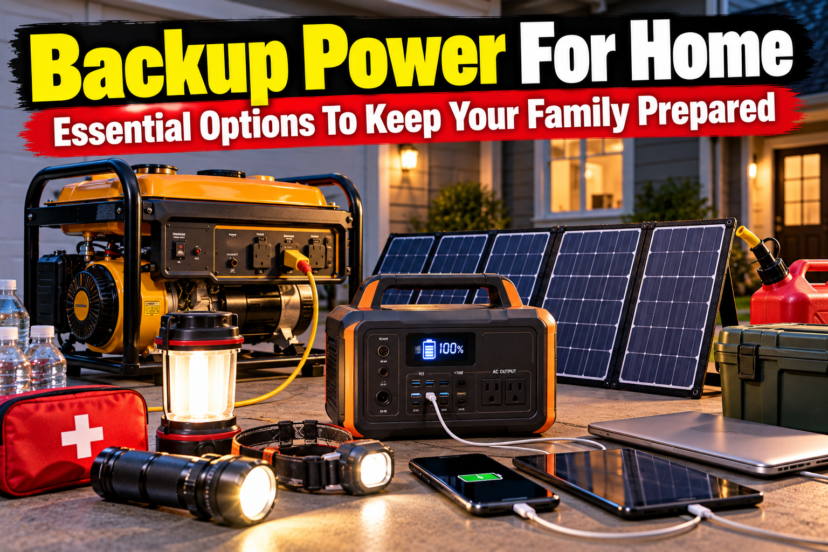
A $30–$50 power bank can keep a phone working. A portable battery station can support several small devices. Solar panels can help replenish stored energy during longer outages. Portable and standby generators can provide substantially more power when properly sized and safely installed or operated.
The goal is not necessarily to power your entire home. It is to identify what matters most and build a realistic backup system around those priorities.
⚡ Quick Answer: What Is The Best Backup Power For Home?
The best backup power for home depends on what you need to operate and how long outages typically last. Power banks work well for phones and small electronics. Portable power stations can run multiple devices and some appliances. Solar panels can replenish compatible batteries, while portable generators provide higher output but require fuel and strict safety precautions. Whole-home battery systems and standby generators offer greater capability but usually involve professional installation and higher costs.
Key Takeaways
Most likely cause: Hurricanes, thunderstorms, ice storms, wildfires, utility failures, extreme weather, and damaged infrastructure can interrupt household electricity.
Usually serious? A brief outage is usually manageable, but longer outages can affect refrigeration, communications, heating or cooling, medical equipment, water systems, and other important household needs.
First thing to check: Identify which devices and appliances you truly need during an outage and determine their power requirements.
Best solution: Build backup power for your home in layers, beginning with affordable battery power for essential devices and adding larger battery, solar, or generator capacity if your household risks justify it.
🔋 1. Power Banks: The Cheapest Place To Start
For basic emergency preparedness, a few USB power banks provide excellent value.
They cannot run your refrigerator, but they can keep phones, small USB lights, and other compatible electronics working. That matters.
Your smartphone may provide emergency alerts, weather forecasts, utility updates, maps, communication, and evacuation information during a disaster.
A 10,000 or 20,000 mAh power bank can provide useful reserve capacity, although actual performance depends on the device being charged, battery condition, and conversion losses.
For a family, consider keeping multiple power banks rather than relying on one.
Label them and store the correct charging cables alongside them.
The biggest limitation is simple: once the batteries are empty, you need another way to recharge them.
That is why power banks work best as the first layer of backup power for home, not the entire plan.
🔌 2. Portable Power Stations: Flexible Battery Backup
A portable power station is essentially a much larger rechargeable battery with multiple output options.
Depending on the model, you may get:
- USB-A Ports
- USB-C Ports
- 12-Volt Outputs
- Standard AC Outlets
This lets one battery system support phones, laptops, lights, radios, fans, and other compatible devices.
Larger units may also operate refrigerators, freezers, CPAP machines, or other equipment for a limited period, provided their output and capacity are adequate.
When comparing models, look at both watts and watt-hours.
Watts tell you roughly how much power the station can deliver at one time. Watt-hours help indicate how much energy the battery stores.
A 1,000-watt appliance cannot necessarily run on a power station just because the battery has 1,000 watt-hours of capacity. Output limits and startup surges also matter.
Match the system to your actual equipment.
☀️ 3. Solar Panels: A Way To Replenish Your Batteries
Battery storage gives you electricity immediately.
Solar gives you a way to potentially replace some of the electricity you use.
A folding solar panel can recharge compatible power stations and smaller battery banks during daylight.
This creates a useful emergency cycle: Solar Panel → Battery Storage → Essential Devices
Solar is particularly appealing for longer outages because it does not depend on gasoline availability.
However, solar production is variable.
Clouds, shade, panel orientation, season, weather, and available daylight all influence output.
A panel advertised at 200 watts will not necessarily deliver 200 watts continuously throughout the day.
That makes solar a valuable backup power option for the home, but it should be sized realistically.
For most families, solar works best when combined with battery storage rather than treated as an unlimited source of electricity.
⛽ 4. Portable Generators: More Power For Larger Loads
Portable fuel-powered generators can provide much more continuous power than typical consumer battery packs.
Depending on size, they may be capable of operating refrigerators, freezers, sump pumps, lights, and other important equipment. But greater power also brings greater responsibility. Portable generators produce carbon monoxide.
They must never be operated inside a home, basement, garage, shed, or other enclosed or partially enclosed space.
Follow current manufacturer and official safety guidance for placement. U.S. safety authorities generally advise positioning portable generators outdoors, well away from homes, doors, windows, and vents, with exhaust directed away from buildings.
Never connect a generator to household wiring by plugging it into a wall outlet.
If you want a portable generator connected to home circuits, an appropriate transfer system should be installed according to applicable codes by a qualified professional.
Generator safety is just as important as generator capacity.
🏠 5. Standby Generators: Automatic Backup Power
A permanently installed standby generator provides a different level of preparedness.
Instead of retrieving equipment and connecting cords after the electricity fails, a properly installed standby system can detect an outage and supply selected circuits—or potentially much of the home—automatically.
These systems commonly use natural gas or propane, depending on the installation and local infrastructure.
Standby generators can be especially useful for households where frequent or prolonged outages create significant problems.
Potential uses include supporting:
- Refrigerators And Freezers
- Heating Equipment
- Well Pumps
- Sump Pumps
- Lighting
- Communications
- Selected Air-Conditioning Equipment
- Other Essential Circuits
The disadvantages are cost, installation requirements, maintenance, noise, and continued dependence on a fuel source.
A standby generator is therefore not automatically the best backup power for home for everyone.
For some households, a smaller portable system is more than enough.
🔋 6. Whole-Home Battery Backup
Whole-home batteries provide stored electrical energy without the exhaust produced by fuel-burning generators.
Depending on system design, they can automatically supply selected household loads when grid power fails.
Some systems are paired with rooftop solar, allowing solar panels to potentially replenish the batteries when conditions and system configuration permit.
Benefits can include quiet operation, no on-site gasoline refueling, and automatic power transfer.
The tradeoff is cost.
Whole-home battery systems can represent a significant investment, and installation typically requires qualified professionals, permits, code compliance, and careful system design.
Battery capacity also remains finite.
Running central air conditioning, electric heating, water heaters, ovens, and other high-demand loads can consume stored energy quickly.
The key question is not: Can this battery power my house?
It is: Which loads do I want it to power, and for how long?
That question produces a much better preparedness plan.
🚗 7. Your Vehicle Can Provide Limited Emergency Power
Do not overlook the large battery sitting in your driveway.
Many vehicles can recharge phones and small electronics through USB ports or 12-volt outlets.
Some newer vehicles offer higher-capacity power outputs, while certain electric vehicles may support more advanced backup-power capabilities when paired with compatible equipment.
Capabilities vary widely, so check the vehicle manufacturer’s specifications.
A conventional gasoline vehicle should never be left running inside a garage to provide electricity because exhaust contains carbon monoxide.
Move it outdoors into an appropriate open location before running the engine.
Also avoid draining your starter battery.
Your vehicle may become essential for evacuation, medical transportation, or obtaining supplies, so do not sacrifice mobility simply to charge nonessential devices.
📊 How Much Backup Power Do You Actually Need?
This is where many families either spend too much or buy too little.
Start with a simple list.
Write down everything you would ideally like to operate during an outage.
Then separate needs from comforts.
Your priority list might be:
- Medical Equipment
- Refrigerator And Freezer
- Phones And Communications
- Emergency Lighting
- Well Or Sump Pump
- Fans Or Essential Heating Equipment
- Internet Equipment
- Laptops And Other Electronics
Check the power requirements for each device.
Pay attention to startup loads from refrigerators, pumps, and other motor-driven appliances.
Then think about duration.
Keeping a refrigerator running for three hours is very different from powering it for three days.
Sizing backup power for home starts with load and time—not with buying the biggest product you see advertised.
🌀 Match Your Backup System To Your Local Risks
Where you live should influence your priorities.
A Florida household preparing for hurricanes may face multi-day outages in hot, humid weather.
A Texas family may be concerned about severe storms, extreme heat, or winter grid disruptions.
Homes in northern states may prioritize heating-system components during ice storms and blizzards.
Western households may prepare for wildfire-related outages or public-safety power shutoffs.
Apartment residents have different needs again.
Operating a portable fuel generator may not be practical or permitted, making battery power stations and smaller solar systems more attractive.
There is no universal best system.
The best setup is the one designed around your household, building, climate, budget, and realistic emergencies.
💰 Build Backup Power In Layers Instead Of Buying Everything
You do not have to spend thousands of dollars immediately.
A practical progression could look like this:
Level 1: Flashlights + Power Banks
Level 2: Larger Power Banks + Vehicle Charging
Level 3: Portable Power Station
Level 4: Compatible Solar Panels
Level 5: Properly Sized Portable Generator
Level 6: Professionally Installed Standby Generator Or Home Battery System
You may never need Levels 5 or 6.
A household experiencing occasional three-hour outages has different requirements from a rural home with a well pump that regularly loses electricity for two days.
Gradually improving your home backup power lets you spend money where it actually improves resilience.
🧰 Test Your Backup Power Before An Emergency
Equipment that has never been tested is not a complete emergency plan.
Try a controlled blackout exercise.
Turn off nonessential electricity for a couple of hours and see what happens.
- Can you find the flashlights?
- Are your power banks charged?
- Will your portable power station actually operate the refrigerator?
- Do you have the correct cables?
- Does everyone understand basic generator safety?
Check batteries and emergency equipment periodically according to manufacturer instructions.
A short test on a calm Saturday can reveal problems that would otherwise appear at midnight during a hurricane.
👷 When To Consult A Professional Or Follow Official Guidance
Consult a licensed electrician when connecting generators, battery systems, solar equipment, transfer switches, inlets, or other backup systems to household electrical wiring.
Never improvise connections or backfeed a home through an electrical outlet.
Follow utility and emergency-management instructions after storms, floods, wildfires, and other disasters.
Keep electrical equipment away from floodwater and treat downed utility lines as energized.
Households with electrically powered medical equipment should develop a dedicated backup plan with healthcare professionals, equipment providers, utilities, and appropriate emergency resources rather than relying on a general consumer backup system.
❓ Frequently Asked Questions
What Is The Best Backup Power For A Home?
It depends on your power requirements, outage duration, property, and budget. Power stations are useful for smaller loads, while generators and whole-home batteries can support larger household needs.
What Is The Cheapest Way To Get Backup Power At Home?
For basic communication and lighting, rechargeable power banks are among the least expensive options. Add larger batteries or other systems only when your needs justify them.
How Big Of A Power Station Do I Need For A Refrigerator?
Check the refrigerator’s operating wattage, startup requirements, and expected runtime. Then select a power station with sufficient output and usable battery capacity, allowing for efficiency losses.
Is A Generator Or Battery Better For A Power Outage?
Neither is universally better. Batteries are quiet and produce no exhaust during use, while fuel generators can provide substantial power as long as appropriate fuel remains available. Some households benefit from having both.
Can Solar Panels Power A House During A Blackout?
Not necessarily. Many grid-tied solar systems shut down during outages unless designed with compatible equipment and battery storage or another approved backup configuration.
How Long Will A Home Battery Last During A Power Outage?
Runtime depends on battery capacity and household electricity use. Essential loads may run much longer than a home attempting to maintain normal high-energy consumption.
Do I Need A Generator For Emergency Preparedness?
No. Many households can cover their most important needs with power banks, portable battery stations, solar charging, or other alternatives. Generators become more useful when larger or longer-duration loads must be supported.
🏡 Start Small And Build A Backup Power Plan That Fits Your Family
Good backup power for home is not about recreating normal life perfectly when the grid goes down.
It is about protecting what matters most.
Maybe your first priority is simply keeping two phones and several flashlights charged.
Later, you may add a power station capable of supporting the refrigerator. A solar panel could extend that capacity. If your household regularly experiences long outages, a properly installed generator or whole-home battery may eventually make sense.
Build in layers. Test what you own. Understand your household’s actual energy needs. And do not feel that preparedness requires buying every piece of equipment at once.
A small battery bank purchased today can make your next blackout easier. Each improvement after that gives you another layer of resilience.
That is practical self-reliance: not preparing for every imaginable disaster, but giving your family enough options to remain safer, calmer, and more capable when the systems you normally depend on temporarily stop working.
Disclaimer: This article is for general educational and preparedness purposes only. Electrical systems, emergency conditions, household needs, equipment requirements, regional regulations, and building codes vary. Always follow local laws, official utility and emergency-management guidance, applicable electrical and fire codes, and manufacturer instructions. Consult qualified professionals for electrical installations, medical power requirements, and situations that may create significant safety risks.
Explore more:
- Food Safety Power Outage: How Long Will Food Last
- Charge Phone Without Power: 7 Reliable Ways
- Most Common Generator Mistakes: 9 Dangerous Errors