Purify Water Without Electricity: 7 Safe Emergency Methods Every Family Should Know
When the power goes out, losing your lights and internet is frustrating. Losing access to safe drinking water can become a much bigger problem. Knowing how to purify water without electricity gives your family another layer of protection when hurricanes, winter storms, floods, wildfires, earthquakes, or major utility failures disrupt normal water service. Homes with private wells can be especially vulnerable because electric well pumps may stop working during an outage.
Fortunately, emergency water preparation doesn’t require an expensive off-grid system. Several proven methods can help make certain microbiologically contaminated water safer without grid power, including boiling over a safe heat source, appropriate chemical disinfection, and properly rated portable filters.
But no single method handles every contaminant. Chemicals, fuels, saltwater, and some toxins require different solutions. Understanding those limits is just as important as knowing the methods themselves.
With a few basic supplies and a simple plan, you can become much more confident about handling a water emergency.
💧 Quick Answer: Purify Water Without Electricity
To purify water without electricity, use safe stored water first whenever possible. If you must treat questionable water, boiling is generally the preferred emergency method for killing disease-causing microorganisms when a safe heat source is available. Proper chemical disinfection or appropriately rated water-treatment devices may also work in certain situations. Always follow current public-health guidance because boiling and ordinary filters cannot make chemically or radiologically contaminated water safe.
Key Takeaways
Most likely cause: Power outages, boil-water advisories, damaged infrastructure, private-well pump failures, flooding, or disasters can interrupt access to safe drinking water.
Usually serious? Potentially. Unsafe water may contain disease-causing microorganisms or other contaminants that can make people ill.
First thing to check: Look for emergency alerts and determine whether officials have identified the type of contamination before attempting treatment.
Best solution: Keep stored drinking water as your first line of defense and learn more than one proven way to purify water without electricity for situations where safe water isn’t available.
🚰 Why You May Need To Purify Water Without Electricity
Most American households depend on several systems working together to deliver safe tap water.
A disaster can interrupt those systems.
Flooding may contaminate wells or municipal supplies. Hurricanes can damage treatment and distribution infrastructure. Earthquakes may break water lines. Severe winter storms can knock out electricity for days.
Private wells create another challenge because many require electricity to operate the pump.
Even if water still flows from your faucet, don’t assume it is safe after authorities issue a boil-water or contamination advisory.
Emergency water treatment is primarily about reducing microbiological hazards when officials say treatment is appropriate. It is not a universal fix for every possible contaminant.
That distinction matters.
If authorities report contamination involving fuel, industrial chemicals, radioactive materials, or another hazard that normal household treatment cannot remove, use an alternative safe water source and follow official instructions.
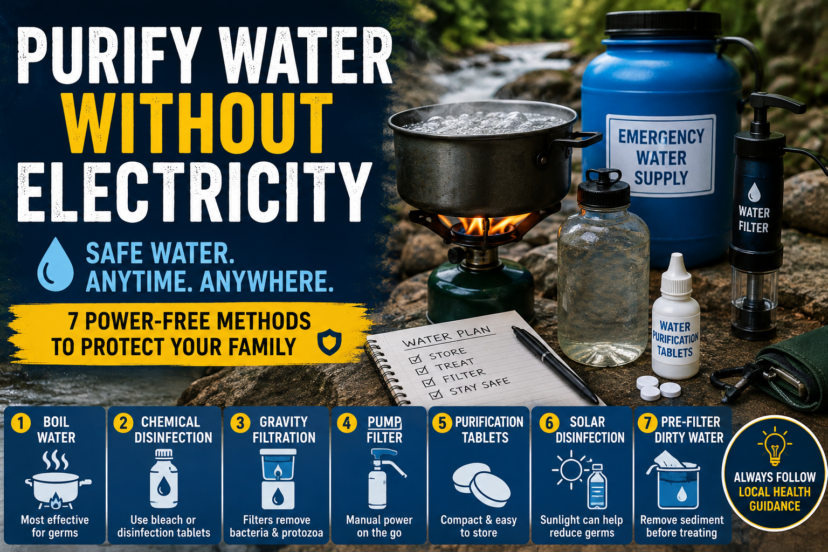
🔥 1. Boil Water Using A Non-Electric Heat Source
Boiling is one of the most dependable methods for treating water contaminated with disease-causing organisms.
If the water is cloudy, first allow particles to settle and filter it through a clean cloth, paper towel, or coffee filter as appropriate. This improves clarity but does not by itself purify the water.
Then bring the water to a rolling boil.
Current U.S. emergency guidance generally recommends boiling clear water for at least one minute. At elevations above approximately 6,500 feet, boil it for three minutes.
Allow the water to cool naturally and store it in clean, sanitized containers.
During a blackout, possible heat sources could include appropriately used outdoor camping equipment or another approved non-electric cooking system.
Never operate charcoal grills, camp stoves, or other outdoor combustion appliances inside a home, garage, tent, or other enclosed area because of carbon monoxide and fire risks.
Boiling also does not remove many chemical contaminants, salts, or radioactive materials.
🧪 2. Use Appropriate Chemical Disinfection
When boiling isn’t possible, chemical disinfection may be an emergency alternative for certain microbiological hazards.
Emergency guidance sometimes recommends regular, unscented household chlorine bleach containing an appropriate concentration of sodium hypochlorite.
The exact amount required depends on the bleach concentration and water conditions, so don’t memorize one universal number and assume it applies to every product.
Instead, keep current official instructions with your emergency supplies and check the product label. Never use scented, splashless, color-safe, or bleach products containing added cleaners for emergency drinking-water disinfection unless specifically directed by appropriate public-health guidance.
Chemical disinfection has limitations. Some parasites are more resistant than others, and bleach will not make chemically contaminated water safe.
Water-treatment tablets are another option. Follow their label directions carefully because treatment times and capabilities vary by product.
🏕️ 3. Use A Gravity-Fed Water Filter
A gravity filter is particularly useful when you need to purify water without electricity because gravity supplies the pressure.
Water is poured into an upper reservoir or bag and passes through a filter element into a lower container.
However, the word “filter” doesn’t automatically mean “makes all water safe.”
Different products are rated for different contaminants.
Some are primarily designed to remove bacteria and protozoa. Others may provide additional treatment. Many common filters do not reliably remove viruses, dissolved chemicals, salt, or every potential toxin.
Before an emergency, read the manufacturer’s specifications carefully.
Look for clear information explaining exactly which contaminants the product is designed and tested to reduce.
A gravity system can be extremely useful, but only when matched to the water hazard you are facing.
🚶 4. Use A Manual Pump Water Filter
Hand-operated pump filters provide another electricity-free option.
Instead of gravity moving the water, you manually pump it through the filter.
These products can be useful for evacuation kits, camping, vehicle emergency supplies, and situations where you need to treat relatively small amounts of water.
Again, check the treatment specifications.
“Outdoor water filter” is a broad category, and performance varies considerably. Some filters target bacteria and protozoa but not viruses. Others combine filtration with additional treatment technologies.
Also remember that filters eventually clog or reach their rated capacity.
Keep replacement components when appropriate and learn how to maintain the unit before an emergency.
The middle of a three-day blackout is not the ideal time to read the instructions for the first time.
🧴 5. Use Water Purification Tablets
Water purification or disinfection tablets are compact, lightweight, and easy to store in an emergency kit.
Different products may use different active ingredients, and their treatment times and effectiveness can vary.
Some require considerably longer contact times for certain microorganisms.
Follow the manufacturer’s instructions exactly regarding:
- Water Volume
- Number Of Tablets
- Contact Time
- Water Temperature
- Product Expiration
- Organisms Treated
Don’t add extra tablets simply because you think more must be better.
A major advantage of tablets is portability. You can keep some in a go-bag, vehicle kit, or evacuation supplies without taking up much room.
They are better viewed as one layer of your emergency water strategy rather than your only solution.
☀️ 6. Understand Solar Water Disinfection
Solar disinfection methods use sunlight to reduce certain microorganisms in appropriately prepared water.
While solar methods can be useful in some situations and regions, they depend heavily on factors such as sunlight intensity, container type, water clarity, exposure time, and correct technique.
That makes them less straightforward than simply saying, “Leave water in the sun.”
For most U.S. households, stored drinking water, boiling, approved chemical disinfection, or appropriately rated treatment equipment provide easier-to-manage emergency options.
Solar treatment may be valuable knowledge for extended emergencies, but it should be learned from reliable public-health guidance rather than improvised during a crisis.
🧹 7. Pre-Filter Dirty Water Before Treatment
If emergency water contains visible dirt or sediment, pre-filtering can make subsequent treatment easier.
Allow heavy material to settle.
Then carefully pour the clearer water through a clean cloth, coffee filter, or another appropriate pre-filter into a clean container.
But remember:
Pre-filtering is not the same as purification.
A cloth may remove leaves, insects, dirt, and larger particles, but dangerous microorganisms can remain.
After pre-filtering, use an appropriate treatment method such as boiling or another method recommended for the situation.
Understanding this difference prevents one of the most dangerous emergency-water mistakes: assuming clear water equals safe water.
⚠️ Water You Should Not Try To Purify At Home
Sometimes the safest emergency water decision is not to treat a questionable source.
Normal boiling, bleach disinfection, and basic camping filters should not be assumed to make water safe if it contains hazardous chemicals.
Avoid attempting to make water drinkable when officials warn it may contain:
- Fuel Or Petroleum
- Toxic Chemicals
- Industrial Waste
- Radioactive Contamination
- Dangerous Algal Or Other Toxins
- Seawater Or Excessive Salt
Boiling chemically contaminated water may concentrate some substances as water evaporates.
In these situations, use commercially bottled water, properly stored emergency water, or another source specifically approved by authorities.
🌀 Choosing A Method During A Real Emergency
Suppose a hurricane knocks out electricity and your city issues a standard boil-water advisory because of possible microbial contamination.
If officials recommend boiling and you have a safe outdoor or otherwise approved backup cooking method, boiling may be straightforward.
Now imagine flooding has affected a nearby industrial site and authorities warn residents not to consume the tap water.
That’s different.
Boiling the water doesn’t automatically solve chemical contamination.
The same principle applies after wildfires, major floods, chemical spills, or other disasters: identify the problem before choosing the treatment.
Keep a battery-powered or hand-crank radio in your emergency supplies so you can receive official information when internet and cellular networks are unreliable.
🛡️ Build A Layered Emergency Water Plan
Learning to purify water without electricity is valuable, but treatment should ideally be your backup plan rather than your first source of drinking water.
Start by storing potable water.
A common emergency-preparedness guideline is at least one gallon per person per day for several days, with more for pets, medical needs, hot weather, and other circumstances.
Then add backup treatment methods.
A practical household setup might include:
- Stored Drinking Water: Immediately available and ready to consume.
- Safe Heating Method: For boiling when appropriate.
- Gravity Or Manual Filter: Selected for specific contaminants.
- Chemical Treatment: Stored with clear instructions.
- Portable Treatment Option: For evacuation.
- Clean Containers: For treated water.
Redundancy means one equipment failure doesn’t leave you without options.
🧰 Make An Electricity-Free Water Kit
You can create a useful water-treatment kit without spending a fortune.
Consider keeping:
- Clean Water Containers
- Metal Pot With Lid
- Appropriately Rated Water Filter
- Water-Treatment Tablets
- Appropriate Disinfectant With Instructions
- Coffee Filters Or Clean Pre-Filter Material
- Measuring Equipment If Required By Official Instructions
- Waterproof Printed Treatment Instructions
- Disposable Gloves
- Battery Or Hand-Crank Radio
Keep everything organized in one labeled container.
Printed instructions are especially valuable. You don’t want your emergency plan to depend entirely on having internet access during a blackout.
❌ Common Emergency Water Purification Mistakes
Knowing what not to do is just as important as knowing how to treat water.
Avoid these common mistakes:
- Assuming Clear Water Is Safe: Pathogens can be invisible.
- Treating Chemical Contamination Like Bacteria: Boiling doesn’t solve every hazard.
- Using The Wrong Bleach: Products vary significantly.
- Ignoring Filter Specifications: Not every filter removes viruses or chemicals.
- Running Outdoor Stoves Indoors: Carbon monoxide can be deadly.
- Mixing Clean And Dirty Containers: Prevent recontamination after treatment.
- Ignoring Official Guidance: Local officials may know exactly what affected the water supply.
A simple, well-practiced method is safer than improvisation.
🩺 When To Consult A Professional
Contact your local health department or emergency management agency when contamination is suspected, particularly after flooding, sewage releases, chemical spills, wildfire damage, or major infrastructure failures.
A licensed plumber or qualified well professional may be needed after a flooded well, broken pipes, backflow event, or suspected household plumbing contamination. Consult a licensed electrician for damaged well pumps, generators, or electrical equipment.
Seek medical care if someone develops concerning symptoms after consuming potentially contaminated water, especially young children, older adults, pregnant people, or individuals with weakened immune systems.
During major emergencies, follow official boil-water, do-not-drink, or do-not-use notices carefully.
❓ Frequently Asked Questions About Purifying Water Without Electricity
1. What Is The Best Way To Purify Water Without Electricity?
For microbiologically contaminated water, boiling is generally the preferred emergency method when you have a safe non-electric heat source. The correct method ultimately depends on the contaminant, so follow official public-health instructions.
2. How Long Should You Boil Water To Make It Safe?
U.S. emergency guidance generally recommends bringing clear water to a rolling boil for at least one minute. At elevations above about 6,500 feet, boil for three minutes.
3. Can Household Bleach Make Water Safe To Drink?
Appropriate unscented household chlorine bleach may be used for certain emergency disinfection situations when official guidance is followed precisely. Concentrations vary, so use current instructions rather than guessing the dosage.
4. Can A Water Filter Purify Any Water?
No. Filters differ in what they remove. A product may remove bacteria and protozoa without removing viruses, chemicals, salt, or other contaminants. Always check its specifications.
5. Can You Purify Floodwater By Boiling It?
Floodwater may contain sewage, fuel, chemicals, and other contaminants. Boiling addresses microorganisms but does not remove many chemical hazards. Use a safer source whenever possible and follow local emergency guidance.
6. Does Filtering Water Through Cloth Make It Safe?
No. Cloth can remove larger particles and sediment, but it does not reliably remove disease-causing microorganisms. Treat the pre-filtered water using an appropriate purification or disinfection method.
7. How Can I Prepare For A Water Emergency Before The Power Goes Out?
Store potable water, keep appropriate treatment equipment and clean containers, print official emergency instructions, and learn how your equipment works. Having several options creates a stronger preparedness plan.
🌟 Final Thoughts: Learn To Purify Water Without Electricity Before You Need To
Knowing how to purify water without electricity gives you another valuable layer of independence when everyday infrastructure fails.
But the smartest strategy begins before the emergency.
Store safe drinking water first. Add an appropriately rated filter. Keep an approved backup treatment method. Print instructions and learn how everything works while your lights, internet, and faucets are still functioning normally.
You don’t need a complicated survival system.
A few containers of drinking water and two reliable backup treatment options can put your household in a much stronger position during a hurricane, winter blackout, earthquake, wildfire, or unexpected water advisory.
Preparedness is ultimately about creating options.
Take one small step today—store some water, check your treatment supplies, or learn how your filter works. Each improvement makes your family more resilient and gives you greater confidence and peace of mind when normal systems are temporarily unavailable.
Preparedness And Safety Disclaimer
This article is for general educational and emergency-preparedness purposes only. Water hazards, treatment requirements, individual health needs, emergencies, and regional regulations vary. Always follow local laws, current public-health and emergency-management instructions, boil-water or do-not-drink notices, and manufacturer directions. Never assume household treatment can make chemically or radiologically contaminated water safe. Consult qualified medical, plumbing, electrical, well-water, or water-quality professionals when appropriate.
 Explore more:
- Bad Stored Water: 9 Warning Signs
- Rainwater Collection For Beginners
- Stored Water Shelf Life: How Long