Bottled Water Vs Water Storage Containers: Which Is Better For Emergency Preparedness?
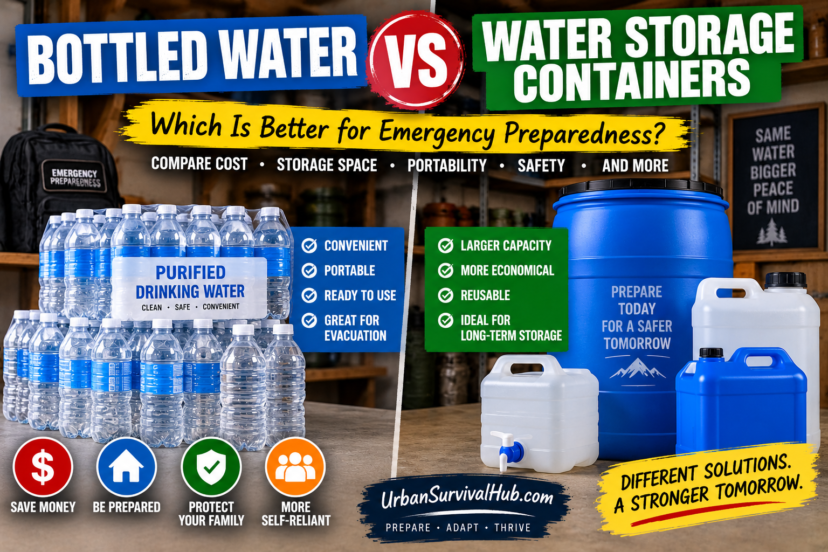
When a hurricane, winter storm, wildfire, or water main break disrupts normal life, having safe drinking water at home can quickly become more important than almost anything else. But when building an emergency supply, many families face the same question: bottled water vs water storage containers—which is better?
The answer is not as simple as choosing one over the other.
Bottled water is convenient, portable, and easy for beginners to store. Larger food-grade containers can hold much more water in less space and may be more economical for building a substantial reserve. For many households, the strongest emergency plan actually combines both.
You don’t need an expensive survival setup to get started. Understanding the strengths and limitations of each option can help you create an affordable water system that fits your home, protects your family, and gives you greater confidence when the unexpected happens.
💧 Quick Answer: Bottled Water Vs Water Storage Containers
When comparing bottled water vs water storage containers, bottled water is usually better for convenience, portability, and short-term emergency kits, while reusable food-grade containers are better for storing larger quantities efficiently. For most families, a combination works best: keep bottled water for immediate use and evacuation while maintaining larger potable-water containers for your main household reserve.
Key Takeaways
Most likely cause: Families often struggle to choose between bottled water and storage containers because each option solves a different preparedness problem.
Usually serious? The choice itself isn’t usually serious, but inadequate or improperly stored water can become a major concern during an extended emergency.
First thing to check: Calculate how much water your household needs, then evaluate your available storage space, budget, and ability to move heavy containers.
Best solution: When considering bottled water vs water storage containers, a layered approach is usually the most practical—use portable bottles for convenience and food-grade containers for larger emergency reserves.
🏠 Why Your Emergency Water Storage Method Matters
A good water preparedness plan has to work when you’re tired, stressed, and dealing with disrupted utilities.
That means capacity isn’t the only consideration.
Your emergency water should also be accessible, safe to store, reasonably easy to manage, and appropriate for your living situation.
For example, a 55-gallon barrel provides excellent capacity, but it cannot realistically be carried during an evacuation. A case of bottled water is easy to distribute but takes more packaging and may not be the most space-efficient way to build a two-week household reserve.
When evaluating bottled water vs water storage containers, consider five main factors:
- Capacity
- Portability
- Storage Space
- Cost
- Ease Of Use
Your goal isn’t to find a universally perfect container. It is to create a system that works for your household.
🧴 Benefits Of Bottled Water For Emergencies
Commercial bottled water offers one major advantage: simplicity.
You purchase it, store it appropriately, and it is ready when needed.
There’s no container preparation or filling process, making bottled water particularly attractive for people who are just beginning to prepare.
Bottled Water Is Easy To Use
Individual bottles can be handed to children, family members, neighbors, or emergency workers without needing cups or pumps.
They’re also convenient for cooking, medications, and monitoring approximately how much water remains.
Bottled Water Is Portable
If a wildfire or hurricane forces you to evacuate, individual bottles and smaller packages are easier to move than large containers.
You can keep some water with:
- Evacuation Supplies
- Emergency Kits
- Camping Gear
- Workplace Supplies
Vehicle temperatures can become extreme, however, so supplies kept in cars require appropriate storage and regular inspection.
Bottled Water Is Easy To Rotate
Another advantage in the bottled water vs water storage containers comparison is rotation.
If your family normally drinks bottled water, you can use older cases during everyday life and replace them with newer supplies.
That creates a simple first-in, first-out rotation system.
⚠️ Disadvantages Of Bottled Water
Convenience comes with trade-offs.
A large household supply can involve many individual bottles and a considerable amount of packaging.
Cases can also be awkward to stack, and thin disposable bottles are not designed to function like heavy-duty reusable storage containers.
For a family of four using one gallon per person per day as a basic planning benchmark, a two-week supply is approximately 56 gallons.
That’s a substantial amount of bottled water.
For households trying to build a larger reserve, reusable containers can make storage more organized.
🛢️ Benefits Of Reusable Water Storage Containers
Purpose-built food-grade water containers offer greater flexibility for larger emergency supplies.
Common sizes include:
- 5-Gallon Jugs
- 7-Gallon Containers
- 15-Gallon Containers
- 20-Gallon Containers
- 55-Gallon Barrels
- Larger Potable-Water Tanks
Smaller containers balance portability and capacity, while barrels and tanks are designed for stationary storage.
Containers Can Store More Water Efficiently
Instead of dozens or hundreds of individual bottles, you can consolidate your reserve into several larger containers.
Stackable designs can be especially useful in garages, closets, utility rooms, and smaller homes.
Reusable Containers Can Be Economical Over Time
There is an upfront cost, but quality containers can be reused according to manufacturer instructions.
This may make them an attractive option for households maintaining a long-term emergency water plan.
Containers Create A More Organized Reserve
Larger containers make it easy to know how much water you have.
Four 5-gallon containers equal 20 gallons. A properly filled 55-gallon barrel gives you a substantial stationary reserve in one location.
This simplifies inventory compared with counting dozens of small bottles.
⚠️ Disadvantages Of Large Water Storage Containers
The biggest problem is weight.
Water weighs roughly 8.3 pounds per gallon before adding the weight of the container.
That means approximately:
- 5 Gallons Of Water Weighs About 42 Pounds
- 7 Gallons Weighs About 58 Pounds
- 15 Gallons Weighs About 125 Pounds
- 55 Gallons Weighs About 457 Pounds
A filled 55-gallon barrel is effectively stationary.
This matters when comparing bottled water vs water storage containers because portability may become critical during evacuation.
Larger containers also require more preparation. They need appropriate cleaning, filling, sealing, storage, inspection, and dispensing equipment.
💰 Which Option Is Cheaper?
The answer depends on local water prices, container costs, and how long you maintain your preparedness system.
Commercial bottled water has a low barrier to entry. You can buy one extra case during your normal grocery trip without making a significant upfront investment.
Purpose-built storage containers cost more initially, but you can refill and reuse appropriate containers following manufacturer and public-health guidance.
For a larger household reserve, reusable containers may therefore become more economical over time.
The most affordable strategy is often gradual.
Instead of buying an entire two-week emergency supply at once, start with bottled water and add reusable containers as your preparedness budget allows.
📦 Which Option Takes Up Less Space?
Larger rectangular or stackable containers generally use storage space more efficiently than dozens of small bottles.
However, large barrels need dedicated floor space.
A 55-gallon drum might work perfectly in a suburban garage but poorly in a small apartment.
Apartment residents may find that 5- or 7-gallon stackable containers offer the best compromise.
Bottled water can also fit under sturdy shelving, inside pantries, or in different storage locations throughout the home.
In the bottled water vs water storage containers decision, your home’s layout matters almost as much as capacity.
🚗 Which Is Better For Evacuation?
Bottled water generally wins for immediate portability.
If authorities tell you to evacuate because of wildfire, hurricane, flooding, or another danger, you do not want your entire water supply trapped inside a 55-gallon barrel.
Small bottles can quickly be loaded into a vehicle or placed with evacuation supplies.
Five-gallon containers can also work, although they become heavy when full.
This is one reason a mixed system is so effective.
Use large containers for sheltering at home and smaller bottles for mobility.
🧼 Which Is Easier To Keep Safe?
Commercial bottled water is convenient because it arrives sealed.
Store it in a cool, protected location and follow manufacturer guidance concerning storage and package dates.
Reusable containers require more work.
Containers intended for potable water should be properly cleaned and sanitized according to applicable manufacturer and public-health instructions before filling.
Keep stored water away from:
- Gasoline
- Pesticides
- Paint
- Solvents
- Cleaning Chemicals
- Excessive Heat
- Direct Sunlight
Inspect your supply periodically for leaks, damaged caps, cracks, unusual odors, or other problems.
📊 Bottled Water Vs Water Storage Containers: Side-By-Side Comparison
| Feature | Bottled Water | Water Storage Containers |
|---|---|---|
| Initial Convenience | Excellent | Good |
| Portability | Excellent | Depends On Size |
| Large-Capacity Storage | Fair | Excellent |
| Space Efficiency | Fair | Good To Excellent |
| Preparation Required | Minimal | More |
| Evacuation Use | Excellent | Best With Smaller Sizes |
| Long-Term Reusability | Limited | Excellent With Appropriate Containers |
| Easy Distribution | Excellent | Requires Cups, Bottles, Or Spigot |
| Best For | Short-Term And Mobile Supply | Larger Home Reserve |
Neither option wins every category.
That is why a combination is often the strongest solution.
🛡️ The Best Emergency Water Strategy: Use Both
Instead of thinking about bottled water vs water storage containers as an either-or decision, think in layers.
Layer 1: Bottled Water
Keep individual bottles or gallon jugs ready for immediate drinking, medications, emergency kits, and evacuation.
Layer 2: Portable Reusable Containers
Five- to seven-gallon food-grade containers provide additional capacity while remaining movable for many adults.
Layer 3: Larger Household Reserve
If you have sufficient space, larger food-grade containers or barrels can significantly expand your water supply.
Layer 4: Backup Water Treatment
A suitable filter, purifier, or other treatment method adds another layer if stored water begins running low.
Remember that no single household treatment method makes every contaminated water source safe. During contamination emergencies, follow instructions from local water utilities and public-health officials.
🏙️ Best Setup For Urban Families And Apartments
You don’t need a huge garage to build an effective emergency water supply.
For a small apartment, consider a modular approach.
You might keep:
- One Or Two Cases Of Bottled Water
- Several Gallon Jugs
- One Or Two 5-Gallon Food-Grade Containers
- A Few Collapsible Containers For Temporary Capacity
- A Suitable Backup Water Treatment Method
Spread supplies across appropriate locations instead of creating one extremely heavy storage area.
Start with enough for a few days and expand gradually.
Preparedness should fit your life rather than take it over.
👷 When To Consult A Professional Or Follow Official Guidance
Water safety can become complicated during serious emergencies.
Follow local emergency management, health department, and water-utility instructions during boil-water advisories, chemical contamination events, floods, and major disasters.
Contact a licensed plumber if damaged pipes, sewage, cross-connections, or backflow may have contaminated your home’s water system. Electrical problems involving private wells or powered water systems should be handled by appropriately qualified professionals.
Seek medical guidance if someone consumes potentially contaminated water and develops concerning symptoms.
If official instructions conflict with your normal preparedness routine, follow the emergency guidance for your location.
❓ FAQs: Bottled Water Vs Water Storage Containers
Is Bottled Water Better Than Stored Tap Water For Emergencies?
Both can be useful. Commercial bottled water offers convenience because it is already packaged and sealed. Properly prepared tap water stored in suitable food-grade containers can be a practical way to build a larger household reserve.
How Much Bottled Water Should A Family Store?
A common emergency-planning starting point is one gallon per person per day for drinking and basic sanitation. A family of four would therefore need approximately 12 gallons for three days, 28 gallons for seven days, or 56 gallons for two weeks.
Are 5-Gallon Water Containers Good For Emergency Storage?
Yes. Five-gallon food-grade containers offer a useful combination of capacity and portability. Remember that a full container weighs more than 40 pounds, so consider who in your household will need to move it.
Is A 55-Gallon Water Barrel Better Than Bottled Water?
A 55-gallon barrel is better for high-capacity stationary storage, while bottled water is better for portability and immediate distribution. Households with enough space can benefit from having both.
How Long Can Water Be Stored In Emergency Containers?
That depends on the water source, container, preparation method, storage conditions, and applicable manufacturer and public-health guidance. Label home-filled containers, inspect them regularly, and follow current recommendations for rotation or replacement.
Can I Refill Disposable Water Bottles For Long-Term Storage?
Purpose-built reusable food-grade water containers are generally a better choice for repeatedly storing emergency water. Disposable bottles are designed primarily for their original packaged use rather than as long-term refillable emergency containers.
Should I Buy Bottled Water Or A Water Storage Tank First?
For most beginners, bottled water is the easiest way to establish an immediate reserve. Once you have a basic supply, adding reusable food-grade containers can provide more capacity and create a stronger long-term preparedness system.
🏡 Final Thoughts: Choose A Water System That Works In Real Life
The debate over bottled water vs water storage containers doesn’t need a single winner.
Each solves a different problem.
Bottled water is convenient, portable, easy to distribute, and ideal for getting started. Larger food-grade containers provide greater capacity, better organization, and a practical way to build a more substantial household reserve.
For most families, the strongest strategy is simple: use both.
Start with enough bottled water to cover immediate needs. Add one or two reusable containers when your budget allows. Build toward a larger reserve gradually. Keep some water portable for evacuation, and consider adding an appropriate backup treatment method.
You don’t have to become a survival expert or spend hundreds of dollars in one weekend.
Preparedness grows through small, useful decisions.
Every gallon you safely store today gives your family another option during tomorrow’s hurricane, winter storm, wildfire, power outage, or unexpected water emergency—and that means greater self-reliance, less stress, and more peace of mind.
Preparedness And Safety Disclaimer: This article is for general educational and preparedness purposes only. Emergency water needs, contamination risks, storage requirements, and regional regulations can vary. Always follow local laws, official emergency-management and public-health guidance, water-utility notices, and manufacturer instructions when applicable.
Explore more:
- Emergency Water Storage Mistakes Most People Make
- Best Water Storage Containers For Long-Term Storage
- Family Emergency Water Supply: How Much Water